I do not think that there can ever be enough books about anything and I say that knowing that some of them are going to be about Pilates.The more knowledge the better seems like a solid rule of thumb, even though I have watched enough science fiction films to accept that humanity’s unchecked pursuit of learning will end with robots taking over the world.-Sarah Vowell

Thursday, May 12, 2016

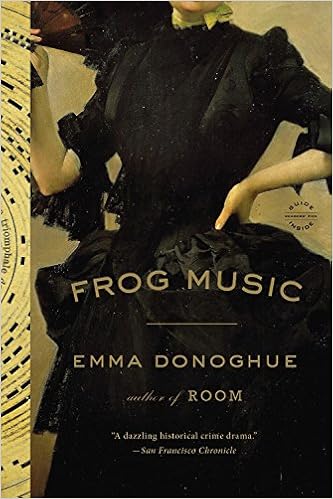
Frog Music by Emma Donoghue


When I read a review of this book I must have overlooked the part about it being based on actual events, because it wasn't until I got to the very end of the book and Donoghue tells what happens to each person that it hits me that these people actually existed. As Mark Twain so famously said: Truth is stranger than fiction. In this fictionalized account of a bizarre murder, which she offers up her own possible solution to, Donoghue really shines.

Set in 1876 San Francisco in the area of Chinatown, during a massive heatwave and smallpox epidemic, the famous French "soiled dove" dancer, Blanche Bleuon leaves the dance hall one night and is run down by Jenny Bonnet on her large bicycle.  Jenny wears men's clothes (which earns her some nights in jails and fines to pay) and earns money as a frog gigger selling her wares to the restaurants. The two unlikely women become friends. Jenny, though, in her own way, let's Blanche see that her life isn't what it seems. Blanche came to America from France with her lover Arthur and their friend Ernest. They had all been in a successful circus back there, but had decided to try the new world, as the bodies of the older men could not continue to for much longer as aerialists. With her money, Blanche buys an apartment building that the three of them share a room in. While Blanche and Arthur have practiced safe sex, over the nine years they have been together Blanche did get pregnant once (and kept right on working, and it ain't at dancing) to a little boy, P'tit. Arthur and her boss convinced her to send him out to the country for his health and she has visits with him occasionally while she still works, supporting Arthur and Ernest and their gambling. Now, Blanche is wondering about her son and questioning other things.

This book goes back and forth in time between what happens several miles down the road from San Fransisco, when one morning as Blanche bends over, a hail of bullets just misses her and kills Jenny in this upstairs room of a farmhouse and how the two of them got there in the first place. The relationship between the two is very complex, and yes, it becomes sexual. This book explores so many things, such as homosexuality, race, prostitution, and life as it could be back then. This book is a real page turner and an eye-opener. Also, it includes bits of old American and French songs and lots of French swear words and phrases (which are included in the glossary in the back).  I cannot recommend this book enough.


Link to Amazon: http://www.amazon.com/Frog-Music-Emma-Donoghue/dp/0316324671?ie=UTF8&keywords=frog%20music&qid=1463065701&ref_=sr_1_1&s=books&sr=1-1

Actual Pictures of the people: http://www.newyorker.com/books/page-turner/inspiration-information-frog-music

Tuesday, May 10, 2016

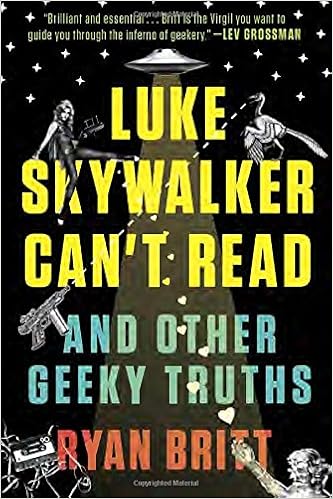
Luke Skywalker Can't Read and Other Geeky Truths by Ryan Britt


This book came out at the end of last year and all I can say, is: what took it so long to be written and where has Ryan Britt been my whole life? Britt's book is a collection of essays, including: Out of the Sideshows; The Birds, the Bees, and Barbarella; I Know It's Only Science Fiction, but I Like It; Luke Skywalker Can't Read; Wearing Dracula's Pants; The Sounds of Science Fiction; Baker Streets on Infinite Earths: Sherlock Holmes as the Eternal Sci-Fi Superhero; All You McFlys: A Back to the Future Theory of Everything; Imagine There's No Frodo (I wonder If You Can); Regeneration No. 9; No, Luke, Captain Kirk Is Your Father; Hipster Robots Will Save Us All; Nobody Gets Mad About Hamlet Remakes: Rise of the Relevant Superheroes; and The Fans Awaken.

As a librarian, one of my favorite essays is, of course, "Luke Skywalker Can't Read". At some point growing up, as he found himself relating to Luke, he noticed something glaringly different: Luke didn't have a favorite book, because he never looked at a book. Luke, the ultimate dreamer, who wants to go on a grand adventure, doesn't get this idea like a lot of us do, from books, but because he is bored to death with farming and wants to get the hell off the dusty planet of Tatooine. The more you look into the trilogy, you notice that those that inhabit it are basically functionally literate. They know enough to read something off a screen, but usually R2-D2 is there to translate. If you look at the controls on ships you see symbols, but these could just represent what it does, like trash compacter or tractor beam. For my Star Wars purist, he does go into Aurebesh, the "official" language of Star Wars written by John Hazlett in the 1990s for the Star Wars roll playing game, and later wrote an article about, "The Written Word". Star Wars, though is not the only place reading does not seem to take place. Narnia is another one. And in the places where reading does take place, there are different results. At Hogwarts, Hermione is the only one who really loves to read. In Lord of the Rings, Gandalf is always dusting off old scrolls and reading up to find out something that will help the group, while the Hobbits, bless them, have written a book: Bilbo's The Hobbit or There and Back Again. Battlestar Galatica and Star Trek, especially provide more scenes of reading or the use of books. I find it amazing that I never picked up on any of this, really, and I'm the person who is sneaking looks at you to find out what you are reading.

I heard Neil De Grasse Tyson give a speech on "An Astrophysicist Goes to the Movies" and he had high praise for the Back to Future movies attention to detail. So I was surprised when I read the essay Britt wrote on it that pointed out some of it's, well, flaws is a rather harsh word, but I will go with it for now.  First thing is, that it brings about "fake nostalgia". Hill Valley in an every-city in California somewhere, but like "the other house" in Gaiman's Coraline, no one seems to ever be able to leave, or even seems to want to, including Marty who is in a sense an anti-Luke Skywalker. When it opens, its familiarity hooks you so that when it takes you back to 1955, you begin to get all misty-eyed. Next are the paradoxes of Marty and Doc and the Biff Tannen family tree. When you meet Doc and Marty they are "already friends FOR NO GOOD REASON AT ALL." Today, any blockbuster have most of the movie be about the origin story of the characters, but that doesn't happen here. We have no idea how or when these two became friends. And Biff seems to be his own ancestor in all three movies. My favorite is the George McFly writing career paradox. Some say that at the end of the first movie, George's comfortable living makes no sense if he had just published his first book. Of course he could have been writing for TV before, as they lived in California. "You could even say that in Marty's reality, George McFly sued both George Lucas and Gene Roddenberry over the use of his original concepts "Darth Vader" (Star Wars) and the planet "Vulcan" (Star Trek)....And if Marty McFly, through his father, actually created both Star Trek and Star Wars via paradox, Back to Future becomes a work of fake nonfiction and ubermetafiction simultaneously."  Also, there's the fact that the past and future in these movies are far from perfect. It gives a bizarre look at race in 1955, while at the same time giving a weird representation of whiteness as well.    

Basically the only reason The Lord of the Rings exists is because Tolkien's publisher bugged him about writing a sequel to The Hobbit. "I am a little perturbed. I cannot think of anything more to say about hobbits." Tolkien believed it at the time, but ten years of thinking about it and his change of mind would change the world of fantasy fiction forever. He also wanted The Silmarillion to come out first, but was, thankfully talked out of that one. Britt compares Tolkien to Lucas, in that both are "insane historical revisionist..though, totally unlike Lucas, a wildly successful one."  Tolkien basically rewrote 1937's The Hobbit and it was republished in 1951 and that is the only copy you will likely find now. The two are radically different. "Specifically, Gollum goes from being a curious creature with funny opinions about things to a straight-up murderous psychopath. Furthermore, the original version of The Hobbit doesn't indicate at all that the Ring was bad news."  With it revised, it could be compatible with his vision of The Lord of the Rings. And you know what? No one cares. The plot is simpler than The Hobbit too. With a few exceptions such as Tom Bombadil, the main plot focuses on WHERE IS THE RING NOW? The Hobbit? Well, there's goblin attacks, giant spiders, eating, singing, etc... This is why it did not work out well being broken into three movies, Peter Jackson. "The characters in The Hobbit are forced in their film adaptions to sustain themselves over narrative distances they were not designed to cross. Peter Jackson tried to turn The Hobbit into The Lord of the Rings when he made his film adaptations of the novel, and If J.R.R. Tolkien had attempted the inverse--to make The Lord of the Rings a true sequel to The Hobbit--nobody would have liked The Lord of the Rings. The creation of The Lord of the Rings is Tolkien, effectively, and brilliantly, selling out, which is exactly like the Beatles firing Pete Best." And if that's selling out, I'll take it any day of the week and twice on Sunday. Because without The Lord of the Rings we would have no Star Wars and Harry Potter (Obi-Wan and Dumbledore, two wizards sacrificing themselves), or the popularity of fantasy fiction in the first place.

This book is both thought provoking and side-splitting laugh provoking. As well as eye rolling, saying out loud to yourself "That is So True!", or "No Way!". I really was up all night reading this book because time just ceased to exist. It was always just one more and then I'll go to bed. But this book totally hooked me. One lesson he really imparts is the importance to stand up and not accept a movie or a book or a show just because it is "geek". And not to slam one, just to try to prove something. I've had two good friends whose opinions matter to me give me offer alternate ways to torture myself, rather than go and see the Batman vs. Superman movie. It seems even Wonder Woman wasn't enough to save it. Yet, it is doing so well at the box office still. I read the title of an article call it "Too Big to Fail". I'll wait until it gets to the library to watch it on DVD (I can always fast forward), because I really want to watch the Wonder Woman movie and I imagine I will need the skinny from this movie before I watch it. It's important that we geeks speak plainly out there for everyone and call it like we see it. And I see you reading this book, because it is one of the best things I've read this year.

Note: At the end of this book is "A Totally Incomplete Glossary of Terms" that will have you rolling in laughter.

Link to Amazon: http://www.amazon.com/Luke-Skywalker-Cant-Read-Truths/dp/0147517575?ie=UTF8&keywords=luke%20skywalker%20can%27t%20read&qid=1462902717&ref_=sr_1_1&sr=8-1

Thursday, May 5, 2016

Star Wars: Lords of the Sith by Paul S. Kemp


This book in the new cannon of Star Wars lore that is leading to the next movie, The Force Awakens, takes place sometime after Revenge of the Sith.  The planet Ryloth, whose inhabitants are called Twi'leks (there's one in Return of the Jedi in Jabba's palace, who is a dancing slave girl who is green and has twin tails coming out of the back of her head) are routinely used for slave labor and the spice mines on their planet are invaluable.  Cham has been leading a rebellion for a free Ryloth for years, slowly building up weapons, people, and ships in order to strike out against the Empire and take their planet back.  His second in command, Islev, is a former slave who is mainly interested in taking down the Emperor and Darth Vader.

While waiting for one of the teams to arrive at a rendezvous point in an imperial ship containing a large shipment of weapons, he shows up with fighters on his tail and a star destroyer on the way.  The Empire ships make quick work of the ship and Vader himself enters the ship and kills off the whole crew while Cham and his people listen in.  Cham recognizes the sound of what he thinks is a light saber that the Jedi's used during the Clone Wars. He, nor his people, have any idea what Vader is, or how formidable he can be.

Cham, with the help of an odious man named Balock who keeps an eye on things for the Moff, who lives on the moon, conducts covert operations to build up their rebellion.  The Moff is completely clueless as to what is going on and Balock, who thinks he is controlling the rebels, soon finds it is the other way around.  Cham plans on destroying a star destroyer that is coming to the planet, with not just their Senator, but also Vader and the Emperor.  Cham makes careful plans on how to take down the star destroyer and if they can kill Vader and the Emperor, even better.  This could mean freedom for his people.

Things seem to be going as planned, with unfortunate losses on their side, but Vader and the Emperor and the Moff on a different ship, crash land on the planet.  Vader and the Emperor find themselves at the equator in a jungle, with communications shut down by the rebellion, and strange and powerful beasts intent on destroying them.  As they run through the jungle, Cham finds their location, and he and some soldiers arrive to hunt them down and kill them, if they can be killed.

This book is a little bit sad, because you know that they will fail in killing Vader and the Emperor because of the next three movies.  The characters are not only engaging, but you find yourself connecting to them and hoping that maybe they will succeed.  I do not know for sure, but this could be the beginning of the Rebel Alliance.  You also get to see the Emperor really showing his powers here.  Normally he cannot, because no one must know he is a Sith Lord, but here, you see his true nature, also through his relationship with Vader.  You might even like the Moff, if for no other reason than Balock is so horrible she seems better, even though she works for the Empire.  This is a must read if you haven't seen the seventh movie yet.

Quotes
Yoda once had told him that fear led to hate and hate to suffering.  But Yoda had been wrong.  Fear was a tool used by the strong to cow the weak.  Hate was the font of true strength.  Suffering was not the result of the rule of the strong over the weak; the Force mandated order.  The Jedi had never seen that, and so they’d misunderstood the Force and been destroyed.
--Paul S. Kemp (Star Wars: Lords of the Siths p 6)
 
The past is a ghost that haunts us. Ghosts must be banished.  Lingering on the past is weakness, Lord Vader.
--Paul S. Kemp (Star Wars: Lords of the Sith p 147)
 
He wondered if he’d completely lost his mind, but then figured that people who’d gone insane never wondered if they’d gone insane.
--Paul S. Kemp (Star Wars: Lords of the Sith p 263)

Link to Amazon: http://www.amazon.com/Lords-Sith-Paul-S-Kemp/dp/034551145X?ie=UTF8&keywords=lords%20of%20the%20sith&qid=1462462142&ref_=sr_1_1&s=books&sr=1-1

Wednesday, May 4, 2016

Star Wars: The Empire Strikes Out and Darth Maul's Mission and The Padawan's Menace

In honor of May the Force Be With You Day I am reviewing three absolutely delightful and hilarious kid's books. They are worth far more than the few dollars they sell for. I laugh my rear off every time I read them. And here is why.

Darth Maul's Mission is basically a telling of The Phantom Menace, but much better (and the whole planet Naboo thing is left out, which means no Jar Jar). When Darth Maul goes to Tatooine he sends out tracker droids (who have deerskin caps on) who are are being chased down by Jawas (Utini!), of course! And it just gets funnier as it goes on (There's a Darth Maul Party Town with a limbo using a lightsaber, naturally).

In The Padawan Menace, Yoda, C-3PO, and R2D2 are taking some padawans on a tour of the galactic Senate, when Yoda senses a disturbance in the force, leaving the two droids in charge of the padawans. As Yoda says "Tired of being right every time, I am." when he meets up with a young Ventress. No one notices that a kid has joined the group of padawans. C-3PO and R2D2 get the padawans on a bus, which crash lands on Tatoonie, while the mysterious kid ("I've got a bad feeling about this."), with Cody and Yoda  go to Hoth to chase a battle droid that has plans on it.

The Empire Strikes Out will have you howling with laughter over one particular sequence of lines. This one completely mixes up the movies, which is actually rather fun. Darth Vader has just sent off probe droids to hunt down Skywalker ("Not THIS Skywalker"). Naboo is in this one, as is Darth Maul, who lived somehow and cannot get along with Vader. Luke can't get his mission done, Chewie and C-3PO are flying the Millennium Falcon and Vader crash lands on Tatooine. Then Han fires at a stormtrooper, leaving C-3PO shocked. "'Oh, my stars,' he cried. 'Han shot first!' 'Of course I did, it was me or him,' explained Han. 'Why wouldn't I shoot first?' 'That is a subject of some debate.' admitted C-3PO'" And believe it or not, it ends with a real bang of hilarity.

So, go spend a few bucks, or check your local library for them. And have a great day enjoying Star Wars!

Monday, May 2, 2016

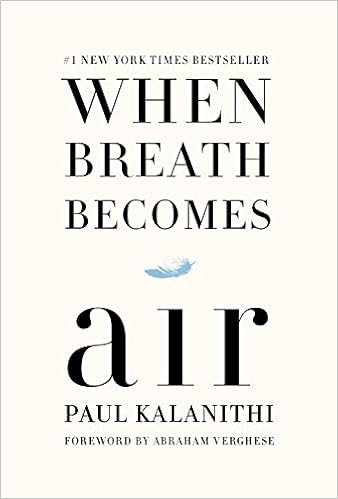
When Breath Becomes Air by Paul Kalanithi


If you have not already heard of Paul Kalanithi, he wrote in early 2014 an op-ed piece for the New York Times called "How Long Have I Got Left?", which caused a bit of a stir. It is not often you read something so magnificently and beautifully written by a neurosurgical resident who is dying from cancer at the age of thirty-six-years-old. But Paul is not a typical anything, really. Here is his vitae: Graduated from Stanford University with a BA and MA in English literature and a BA in human biology. He earned an MPhil in history and philosophy of science and medicine from the University of Cambridge and graduated cum laude from the Yale School of Medicine, where he was inducted into the Alpha Omega Alpha national medical honor society. Her returned to Stanford to complete his residency training in neurological surgery and a postdoctoral fellowship in neuroscience, during which he received the American Academy of Neurological Surgery's highest award for research.  Impressive, huh? His journey is an unusual one, but a very fascinating one. And, yes, going in you know that he did not live long enough to finish it, but that does not matter.

The first page you read will tell you in great detail that every name has been changed to protect the privacy of the patients. And when they say every name, they include names of other doctors he worked with and friends. They go to great lengths to completely obscure things, and not just because they have a legal obligation, but because they have a moral one. In this day and age, there is always some idiot out there who will give it a try to figure out who these people are for whatever reason. I'm rather confident that they will not be able to.

He opens with a prologue that takes you through the time he was discovering that something might be wrong. A residency is a very difficult time. As they say, "The hours are long, but at least the years are short." A neurosurgical residency is another kettle of fish. His marriage was starting to show strain. His wife Lucy, a doctor in internal medicine, knew that he was keeping things from him and they were barely seeing each other. His back was aching and he was losing weight, but an X-ray, something he knew wouldn't show what he suspected it might be, no matter how ridiculous, was clear. And then he started gaining weight and his back eased up. The massive fight came about when she found out that he appeared to still be worried about it and wasn't talking to her. The symptoms came back with a vengeance and he went to his PCP to have a chest X-ray, which showed that he had lung cancer. [I do feel the need to insert here that he was not a smoker, or around second hand smoke. It's cancer. We do not understand everything about it. Sometimes people just get it.] The two of them were already in the process of trying to find a way to mend fences when the diagnosis came in and there was no question then of what really mattered most to them.

But that is not where he started out. His father, a doctor (as is his uncle), moved the family from Bronxville, New York to Kingman, Arizona because the cost of living was less and he was hoping to be able to send his sons (Suman, Paul, and Jeevan) to the best colleges and to establish a regional cardiology practice of his own. His mother is Indian and Hindu, while his father is Christian, which meant the marriage was condemned on both sides and a great many familial rifts. It also meant that his mother was forced to face her extreme fear of snakes. Paul's older brother, Suman, went off to Stanford when they moved, after graduating from an elite prep school back in New York. At that time, it turns out, the U.S. Census had identified Kingman "as the least educated district in America." [I really would have expected that to have been in Mississippi or North Carolina as the two states seem to be in a battle over the decades over being last in education. But this is one school district, not all of them in one state.] His mother was horrified. She would cry at night, worried that her children would not be able to get into college.

This did not, however, last for long. His mother is a force of nature. I don't think Kingman knew what hit it. She had been trained in India to be a physiologist, she married at age twenty-three and became a mother and raised three boys instead. Now she was going to educate them herself. She got a hold of a "college prep reading list" and began handing them to Paul. He was ten when she handed him his first book, 1984 by George Orwell. His reading list over his lifetime is amazing and puts me to shame. When he was twelve he was picking them out for himself and his brother Suman was sending him books he had finished reading in college. His mother joined the school board, "rallied teachers, and demanded that AP classes be added to  the curriculum. She was a phenom: she took it upon herself to transform the Kingman school system, and she did."

When he went off to Stanford he "was driven less by achievement than by trying to understand, in earnest: What makes human life meaningful? I still felt literature provided the best account of the life of the mind, while neuroscience laid down the most elegant rules of the brain."  He would spend a great deal of time reading and studying trying to figure out human nature and life, until one fateful summer when a choice is presented: an opportunity of a lifetime to study rare birds or be a chef at a summer camp in the Sierra Nevada Mountains actually living life.  Yeah, his biology advisor nearly had an apoplectic fit.

But pursing an MA in English literature did not provide the answers he sought either. Even though his father, uncle, and now his brother Suman (who became a neurologist) were doctors, it never occurred to him to be one. But now he was thinking that the answers he wanted he would likely have to find in medicine. He had to wait about eighteen months to get into med school, so he used the time to take the classes he needed and to get that MPhil over in Cambridge. He met his wife, Lucy, at medical school. He chose neurosurgery because it "seemed to present the most challenging and direct confrontation with meaning, identity, and death." They married after med school and headed to California for their residencies: him at Stanford, her at UCSF Medical School.

"My first day in the hospital, the chief resident said to me, "Neurosurgery residents aren't just the best surgeons--we're the best doctors in the hospital. That's your goal. Make us proud." The chairman, passing through the ward: "Always eat with your left hand. You've got to  learn to be ambidextrous." One of the senior residents: "Just a heads-up--the chief is going through a divorce, so he's really throwing himself into his work right now. Don't make small talk with him." The outgoing intern who was supposed to orient me but instead just handed me a list of forty-three patients:"The only thing I have to tell you is: they can always hurt you more, but they can't stop the clock." And then he walked away."

Now, here is where neurosurgery residency is different. About midway through, you have to go away for additional training in some other field. An example he uses is neurosurgeon-journalist Sanjay Gupta. But mostly, the doctor will choose something a little closer to the pasture. He, of course, chose neurosurgeon-neuroscientist (one of the hardest) and spent about a year or two working in a lab that develops neural prosthetic technology that, for example, helps a paralyzed person mentally control a computer or a robot arm. Paul wanted to write signals into the brain, or neuromodulation. This would, for those using a robot arm, be able to feel how hard they are holding something, before they break it. But much more importantly, if you can control neural firing in the brain, which is what this this would be doing in a much broader sense, this would lead to innumerable treatments of currently "untreatable or intractable neurological and psychiatric diseases, from major depression to Huntington's to schizophrenia to Tourette's to OCD." This would not just be ground breaking science, it would be a miracle for those who have these diseases. Which leaves me struggling a bit with the fact that his God (who is my God as well) would take him from this earth at thirty-six. He was extremely intelligent and once he finished with this lab, it would be something that he continued working on his whole life. There would have been a very good chance that he could have found the answer, or if not, at least moved science way down the road and made great advancements that so many could built upon in ways I cannot even begin to imagine. But that was not to be his fate.

There are many stories from his time of residency. Don't worry, the man's feet are indeed made of clay. He goes in with lofty ideas. What doctor doesn't? But he finds himself becoming immune to the human condition and being the doctor I'm sure we've all come up against at some point or another. What does make him an extraordinary man is that he realizes this and vows to do better and does. But he is still human. His diagnosis  came when he was just finishing up his residency and being assured of the position at Stanford of professor of neurosurgery-neuroscientist (as well as at many other places). He and Lucy were at the point of wanting to have children. Now it became a question of should they, as he had no idea if he would be around for a month or the next ten years or what. Was it fair to her to burden her with that? Does he try to go back to being a neurosurgeon? What is it that he really wants out of life? He had spent so much time reading up on life and death and trying to figure it out, but it's not until you are staring it in the face, that you truly understand it.

Note: This, to yours and my great surprise, is not an overly sad book. It is quite a reflective book on a life lived and a look at death. He died before he could finish this, but if feels finished. But that is why one has editors, after all. His wife writes a lovely epilogue that fills in the blanks at the end and really explains who he was to her, a different man than what you find in the book. And that he was laid to rest in a willow casket in a field overlooking the Pacific and that just makes me feel so much better. I really do like willows and the Pacific is so beautiful.
Note: For further reading on cancer, I suggest, though have not yet read, The Emperor of All Maladies: A Biography of Cancer by Siddhartha Mukherjee. Also, Ken Burns amazing (but what has he done that wasn't amazing?) three part, six hour documentary The Emperor of All Maladies, which I have seen and highly recommend.

Link to Amazon: http://www.amazon.com/When-Breath-Becomes-Paul-Kalanithi/dp/081298840X/ref=sr_1_1?s=books&ie=UTF8&qid=1462210151&sr=1-1&keywords=when+breath

Friday, April 29, 2016

Mechanica by Betsy Cornwall


This is the Cinderella story you have been waiting for your whole life. I've read the original and it's gruesome and good. I grew up with the empty-headed, impossibly nice blonde Disney version. This is the one you want your sons and daughters to read because it's cool and it rocks.  It takes the story and turns it on its head and creates a whole tumultuous world to put it in.

Nicolette Lampton's mother was an inventor. She made mechanical insects that did household chores but were also pretty enough to wear as an adornment. Her husband sold them, because he was a really good salesman and she was not and because the people of Esting would find it hard to accept a woman inventor. Long ago, a king of Esting went searching for a bride (no one talks about it aloud, but the royals and nobles go to other lands to seek spouses due to inbreeding). He discovered the land of Faerie and since they were stronger, he planted his flag and declared himself in charge of the place. In Faerie, there are no husbands or wives. They live with friends and when they want a child, one is chosen to bear the child and they get together and wish it into being. This is also how they create their officials, who are a combination of everyone.  A human and a fey can also wish a child into being, which the Brethren (the religious order of Esting) see as an abomination. The fey are seen as savages, of course. But they have magic, which Esting can use.  Nicolette's mother's inventions run on that magic.

Nicolette's father spends a lot of time traveling and her mother spends a lot of time in her lab, but her mother does spend time teaching her, and Nicolette works on fixing her mother's machines around the house. They have a housekeeper, Mr. Candery, who is half-fey.  She and her mother have fey wallpaper and drink fey tea. Her father is not so enamored with the fey as his wife who tells him that they can't keep treating the fey the way they do, or there will be consequences. The king's wife Nerali comes down with fey croup (for once the dominated group that usually gets sick from the diseases of those who take over, is the one getting sick). This is a very treatable illness.  A fey doctor is sent for and she is given lovesbane. Unfortunately, she is given too much, which is deadly, and she dies. So the king outlaws lovesbane. Then he outlaws magic and makes all the fey go back to Faerie (but not the half-fey). At this time, Nicolette's mother comes down with fey croup herself and her father refuses to try to get lovesbane to treat her and she dies. Nicolette is nine.

When her father remarries, Nicolette is excited, because she will get two step-sisters, Piety and Chastity, and she imagines all the things they can do together. She makes up their rooms herself with great care. They, of course, trash them.  Her father and new step-mother return early from their honeymoon when Heir Phillip is assassinated. Tensions rise in Esting. The king cuts off all trade with Faerie. No ships are to leave or come into Faerie. Then a skirmish happens in the market, and Nicolette's father is killed.   Nicolette is ten. Mr. Candery comes to her briefly before he is forced to leave and shows her where all the magic powders are stored so she can use them with the machines to make cleaning the house easier.  He also warns her to be very careful of her step-mother. She won't be, of course. Kids never are.

The next six years pass in a haze. On her sixteenth birthday, a letter appears under her door. It is from her mother and says it supposed to be given to her on her sixteenth birthday. She is happy that her step-mother did this for her. When she opens it up, her mother leaves her a message about where to find the key to her secret lab that Nicolette thought had been burned when she died.  She finds the key and opens the door to a wondrous place. It takes some coaxing, but soon the insects and other things come out from hiding to greet her, including a very special horse named Jules II, who seems almost alive, even though he can be held in her hands and is made of glass and copper, with coal in his belly.  There's also a sewing machine, which is great for her, as she hates sewing, and it takes so much of her time. She spends a great deal of time at night in the lab learning as much as she can from her mother's books and from the journals she slowly finds, that tell her more than just how to make something, but also personal information from her mother.

The king has decided to hold an Exposition of Arts and Science with a ball.  He wants to show how Esting can be incredible without magic. The steps are excited because Heir Christopher will have to be at the ball and this is their chance.  The king, worried about another assassination, has kept him hidden from view his whole life.  Heir Christopher will also be judging the inventions. Nicolette couldn't care less about the ball. She's interested in the Exposition. If she can show something there and get a patron, she can leave the steps and make enough money to buy her family's home.

She needs money, though for supplies. So she invents the knitting machine that knits lace. And she has just started learning to blow glass and has some glass beads.  When the steps send her into town to get material for a whole wardrobe to wear in preparation for the teas, luncheons, and of course ball gowns they will need, she goes to Mr. Waters. He is having a great deal of trouble with his sewing machine. It is completely broken and without it, he will go bankrupt. He had always been nice to her and Nicolette sees an opportunity for a swap. She fixes his machine and the only thing she asks for in return is some material for a dress to wear to the Expedition. She knows if she wants to sell her invention, she has to look the part. In her lab, she has hooked up the insects and Jules to the sewing machine and they now sew, but Jules, in seems, can also design clothes too. This frees her up to do other things. With the spare cloth from the clothes, she dyes the beads different colors.

She waits until a Saturday when the steps will be out for the day and heads into Esting, a place she hasn't been to in years. It's Market Day and she has no idea how it works. Luckily, she comes across Caro, a very fair girl, and Fin, a young man with chocolate skin and dark curls. Cari is immediately friendly and Fin is a bit of a flirt, with an easy smile and a wink. He makes gorgeous carvings and she makes music boxes. She calls herself Nick Lark, as Nick is the name the steps call her by, and Nicolette seems too formal for where she is. They make room for her at their booth and she promises to pay her share of the booth rent money as soon as she earns it. She only has one knitting machine, but right away a Lord Alming, whom she remembers reading about in her mother's journals, shows up and wants to buy one. She sells five more and then has to put it away because she can only make so many right now. She also sells out of beads.

When she gets home, she finds that her step-mother has discovered her lab and the steps have trashed it (except for the sewing machine, of course). They now know she is a mechanic. So they dub her Mechanica. They lock her in her room (she knows how to pick locks), but Cara appears at her window and Nick finds a way down. Cara takes her into the forest to a special place that Nick's mother told her about in a story. A long time ago there was an evil king and the Queen of the Forest provided shelter to the people in the treetops for all time.  These shelters still exist. She talks with Cara and Fin about her situation and Cara tells her that she will sell her stuff at the market and buy her her supplies, for a fee. It seems that Cara's mother has the fey croup and is dying and Cara will not accept charity money from anyone to buy lovesbane at the secret Night Market.

Nick cleans up the lab and gets to work. Cara provides more than just supplies; she gives her long letters filled with stories about her large family and such and the two begin a rich correspondence, becoming really close friends.  She also finds herself falling in love with the handsome Fin, who appears to be the bastard son of a foreign nobleman who married a woman from Esting. She has long conversations with him in her head, imagining a possible romance. All the while, she is also working on her special invention for the Exhibition.

Yes, she does go to the ball the night before the big Exposition, in mechanical glass slippers she made herself (this is just one of the reasons why she is way cooler than Cinderella), dances with a prince, loses a shoe, and leaves at midnight. But not for any of the reasons you think. And there's even a reason why the steps don't recognize her. After that, though, you leave the fairy tale in the dust (what there was of it to begin with). In the end, Nick doesn't need a fairy godmother to save her, or a prince. She saves herself, with a little help from her friends. And that is a lesson we should all learn.

Quotes
I had not yet begun to fathom that when Mother and Father disagreed about something, it meant that at least one of them had to be wrong; it had only recently occurred to me that they fought more often than they did anything else.
-Betsy Cornwell (Mechanica p 26)I was filled with a sudden curiosity and envy. Dance was hardly something Mother would have taught me. There wasn’t much time for it between engineering and theoretical physics, and neither she nor Father had been much for dancing.
-Betsy Cornwell (Mechanica p 53)Of course I wanted to talk to him. I wanted to talk to him too much, which was precisely why I couldn’t think of anything to say.
-Betsy Cornwell (Mechanica p 156)I’d spent so long trying to make the world think I was unremarkable; I realized now that I needed people to think of me that way. If anyone really thought I was special, they would ask things of me, things I didn’t think I could give.
-Betsy Cornwall (Mechanica p 161)Wishing is a frustrating business. There are far too many variables, infuriating for the scientific mind.
-Betsy Cornwall (Mechanica p 197)Nothing exists in your mind the way it does in the real world, she’d said. One must always account for the vagaries of truth.
-Betsy Cornwall (Mechanica p 207)Caro was right. None of us could truly promise the others that we would always be friends.  But always, I knew, was a long time—a time in which mothers could die and fathers be killed, housekeepers be sent away. Steps come and go. A whole life could change, and change again, in the smallest fraction of forever.-Betsy Cornwell (Mechanica p 207)


Link to Amazon: http://www.amazon.com/Mechanica-Betsy-Cornwell/dp/0547927711/ref=sr_1_1?s=books&ie=UTF8&qid=1461936626&sr=1-1&keywords=mechanica

Tuesday, April 26, 2016

A Test of Wills by Charles Todd


In this first Inspector Ian Rutledge mystery, he has just returned a shell shocked veteran of World War I who hears the voice of one of the men he served with, Hammish, in his head whenever he gets stressed.  In an effort to save his sanity he hopes to drown himself in his work and soon finds himself being set up on a case that could ruin his career.

A Colonel in the British Army whose estate is called Mallows, his found with his head blown off by a shotgun in his fields after his horse returns covered in blood.  The problem is everyone seemed to like the Colonel.  The only man who didn't, Mavers, a malcontent who preaches communism and the oppression of the landowners, has an alibi.  He was in the village square all morning yelling to anyone who could hear his rhetoric. 

The night before the Colonel's murder, a Captain in the British Air Force, Mark Wilton, who is supposed to marry the Colonel's ward, Miss Lettice Wood, has a heated argument and slams the door on his way out with the Colonel screaming "I'll see you in hell first".  The next morning, an hung-over shell shocked veteran witnesses the two arguing with each other in the field.  The problem is, the Captain was awarded the Victoria Cross and is a friend of the royal court.  Arresting him would cause a lot of problems and would likely end Rutledge's career. 

Rutledge worries continuously that his knack for being able to figure out why a person died and therefore leading him to the killer, that he had before the war, is gone.  He can't figure out who exactly the Colonel is or who would want to kill him.  And the word of a drunk, shell shocked vet, isn't worth much in court. 

The only other suspects are Wilton's cousin, Mrs. Davenant, who might have wanted Mark for herself, a local artist, Miss Turrant, whose love affair with a German during the war ended badly perhaps in part to the Colonel, and the mysterious cousins who live in the cottage next to the Mallows estate.  One is a bird watcher who saw Milton on the day in question in an area close to where the road to Mallows was, and the other cousin is an extremely shy recluse.   Also, there's Royston, the man who runs Mallows, who may a secret he doesn't want coming to light.

None of these suspects seem really plausible and the Inspector feels as though he is clutching at straws.  He begins to doubt his sanity and his abilities as a detective, as Hammish babbles in the back of his head, and he tries not to answer him aloud, so that no one my know his secret.  This book is fascinating in that it offers a unique view into the mind of former soldier suffering from shell shock, who is trying to overcome it without resorting to suicide, by delving into a murder that could easily end his career.  I can't wait to read the next one!

Quotes
 He’d learned, in France, to face dying.  He could learn, in time, how to face living.  It was just getting thought the desolation in between that seemed to be beyond him.
---Charles Todd (A Test of Wills p 6)

…Charles once said that the greatest crime of the war was ruining the French countryside for a 
generation.  Not the slaughter of armies, but the slaughter of land.
--- Charles Todd (A Test of Wills p 24)

Women…They always ken the cruelest way to torment a man for what’s he done, witting or no.
--- Charles Todd (A Test of Wills p77)

It isn’t actually a question of guilt or innocence, is it?  It’s a matter of what the jury believes, once we’ve told them what evidence there is on either side.  Give the proper evidence, we could probably convict God.  Without it, Lucifer himself would walk free!

--Charles Todd (A Test of Wills p 94-5)

You aren’t afraid until you’ve got something to lose.  But when you love someone or something, you’re terrified—there’s so much at stake, then, so much at risk, you see…
--Charles Todd (A Test of Wills p 121)

I don’t hold with Freud’s nonsense about dreams, but I can tell you that nightmares strip the soul.
--- Charles Todd (A Test of Wills p 124)

There are many ways to kill…Cruelty will do very well.
--Charles Todd (A Test of Wills p 172)

He wouldn’t go back to failure.  There were other choices.  There always were.  To a man who feared living more than he feared death.
--Charles Todd (A Test of Wills p 208)

Oh, yes.  I’ve learned that life is never what you expect it will be.  Just as you come to the fringes of happiness, touching it, feeling it, tasting it—and desperately hoping for the rest of it—it’s jerked away.
--Charles Todd (A Test of Wills p 232) 

Link to Amazon:https://www.amazon.com/Test-Wills-Inspector-Rutledge-Mystery-ebook/dp/B000SEGJ94/ref=sr_1_1?ie=UTF8&qid=1510665389&sr=8-1&keywords=a+test+of+wills