I do not think that there can ever be enough books about anything and I say that knowing that some of them are going to be about Pilates.The more knowledge the better seems like a solid rule of thumb, even though I have watched enough science fiction films to accept that humanity’s unchecked pursuit of learning will end with robots taking over the world.-Sarah Vowell

Thursday, October 27, 2016

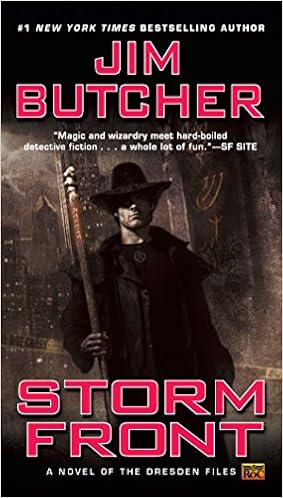
Storm Front: Book One of the Dresden Files by Jim Butcher


Harry Blackstone Copperfield Dresden is a wizard who has a practice as a PI and works as a consultant with the local police in Chicago.  His mother died when he was young and his father, a traveling amateur magician, came home and took him on the road with him.  Sadly, his father, a rather sweet, if an unsuccessful man, died when Harry was in his teens.  Harry sought out a wizard to learn magic from and eventually learned that this wizard practiced the dark arts.  This wizard tried to kill Harry and in his self-defense, he killed the wizard.  The first rule of magic is Do Not Kill.  The White Council, who handles all witch and wizard affairs, were divided as to what to do.  Some thought nothing should be done, as it was self-defense. Others thought that he should be killed anyway because he had taken a life.  The Council ended up placing him under the Sword of Damocles, which meant that if he broke any more rules, he would be put to death, and the Council's executioner, Malcolm, who is not necessarily a bad guy, he just sees things as black and white and believes Harry should have been put to death.  Malcolm is always keeping an eye on Harry, just waiting for the moment when he will mess up.

After Harry receives a mysterious call from a woman, Monica Sells, whose husband is missing, and whom she believes is into something bad, he receives a call from Murph, the tough as nails female cop, who is the only one too really believe that he is a wizard, calls him to a murder scene.  At a hotel, a man who had worked for Johnny Marcone, a crime boss, and a woman, Jenny, who worked for Bianca, a vampire who runs an escort service, are discovered with their chests wide open like wings and their hearts blew to bits on the floor.  Murph believes that magic is involved and Harry agrees with her.  She wants him to find out how this was done and who could have done it.  The problem is, that to figure out how this was done, he might have to explore down some dark avenues that could get him in trouble with the White Council.  Harry cannot explain this to Murph, because if he tells her about the White Council, they will both be dead.

Harry decides to override Murph's order to not visit Bianca and goes to her place completely decked out in magical protective artifacts.  The guard at the gate confiscates the obvious ones, such as his staff and a silver knife, but lets his pentagram necklace and white handkerchief go.  Crosses do not necessarily have an effect on vampires.  Any symbol you wear can have an effect on a vampire if you have absolute and total faith in what that symbol stands for.  The pentagram is a symbol of magic and that is one thing Harry truly believes in.  When Bianca invites him in, she attacks him, believing that Harry had killed Jenny, but Harry's handkerchief contains sunlight, and when he opens it up, the entire room is filled with it and Bianca blackens and backs off.  Once Bianca comes to the realization that Harry is there to find Jenny's killer, she gives him the name of a woman who used to work for her and was friends with Jenny, Linda.

Soon, it appears that everyone is beginning to believe that Harry is the killer, including Malcolm (and possibly the White Council), the police, and pretty much everyone else, including Murph, who thinks that he is at least hiding things from her, which he is, but only for her protection.  Harry creates some potions with the help from his memory spirit Bob, who resides in a skull.  Bob holds the memories of centuries of wizards and is an expert at making potions.  Harry makes a couple of potions for escaping and one, on Bob's insistence, a love potion.  A reporter who had asked Harry out shows up on his doorstep and he has completely forgotten.  Then Harry is attacked at his home by a toad demon, which has been called by the wizard who is killing people, he, on a sudden impulse, uses the lightening in the storm to kill the demon.  This is a very risky thing to do, as lightening is very unstable and uncontrollable.  However, it gives Harry an idea of how the wizard is killing these people.  And it gives the reporter a good story for her newspaper.

A piece of a person is all it takes to perform a spell on them, such as the one that kills them.  When a clipping of Harry's hair is taken, he sets out, in full wizard form with all his wizard accouterments and blows the door off a private club and shows how powerful a magician he really is.  Harry finds out who the wizard is and sets out to stop the guy from killing him.  This turns into an all out brawl where Harry must use his wits, and what little magic he has available to him to try to not end up dead.  This is one powerful scene with a serious blowout at the end.

Harry is a guy that can be down on himself from time to time, but when he needs to be, he can be a force to reckon with.  He may not be a very strong natural wizard, but he makes up for it in knowledge and experience, and just plain guts, or stupidity (as Murph would probably say).  Unfortunately, this case damages his close relationship with Murph, which I hope in future books will be overcome, as they work so well together. 

Quotes


Paranoid? Probably.  But just because you’re paranoid doesn’t mean that there isn’t an invisible demon about to eat your face.
--Jim Butcher (Storm Front p 9)


Maybe my values are outdated, but I come from an old school of thought.  I think that men ought to treat women like something other than just shorter, weaker men with breasts.  Try and convict me if I’m a bad person for thinking so.  I enjoy treating a woman like a lady, opening doors for her, paying for shared meals, giving flowers—all that sort of thing.
--Jim Butcher (Storm Front p 11)


Women are better at hating than men.  They can focus it better, let it go better.  Hell, witches are just plain meaner than wizards.
--Jim Butcher (Storm Front p 21)


I had been a miserable failure in relationships, ever since my first love went sour. I mean, a lot of teenage guys fail in their first relationships.  Not many of them murder the girl involved.
--Jim Butcher (Storm Front p 61)


Kids.  You gotta love them. I adore children.  A little salt, a squeeze of lemon—perfect.
--Jim Butcher (Storm Front p 159)
Link to Amazon: https://www.amazon.com/Storm-Front-Dresden-Files-Butcher/dp/0451457811/ref=sr_1_1?ie=UTF8&qid=1477573843&sr=8-1&keywords=storm+front+jim+butcher


Wednesday, October 26, 2016

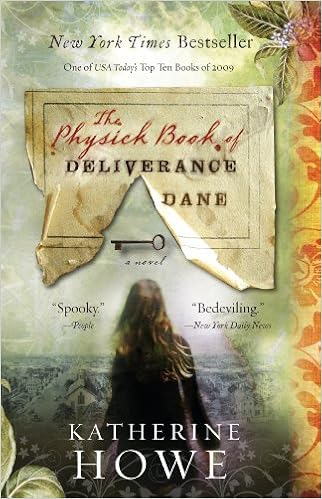
The Physick Book of Deliverance Dane by Katherine Howe


This book opens up in 1681, Salem, Massachusetts, with Deliverance Dane, a cunning woman, being sent to the sick bed of a man's only child, a daughter, who is dying.  His wife has just died a few months ago and now, even though she tries, Deliverance cannot save her.  He accuses her of witchcraft and she goes to court and clears her name.  Fast forward to 1991, and we meet Connie, who is taking her qualifying exams in order to begin her dissertation to get her Ph.D. at Harvard.  Her roommate Liz is in Latin studies, and she has a dog that has adopted her, named Arlo.  Connie's mother is a hippie who hasn't changed any since the sixties and lives in New Mexico reading people's auras.  Connie rebelled by being the exact opposite of her mother: a rule follower and excelling student who stays grounded in the real world.

As Connie's advisor, Chilton, pushes her to come up with a topic for her dissertation, because he sees her as being one of his best students, her mother asks her to go to Marblehead to fix up her mother's house, which has remained empty for twenty years, since Connie's grandmother died.  Grace, Connie's mother, has failed to ever pay taxes on the house, and now it must be sold.  There is no electricity, which means no lights, no phones, no a/c, and no refrigerator, but an ancient icebox instead.  When Connie explores the library and opens her grandmother's bible, an old piece of paper falls out with the name Deliverance Dane on it.  After searching the archives in Marblehead, she heads to Salem, where the oldest church records are kept.  There she meets the handsome steeplejack and restorer, Sam, who is just as fascinated about history as she is and helps her go through the records.  About to give up, they finally look at the catalog of those who were excommunicated from the church and there they find Deliverance's name.  This can only mean one thing: she was accused of being a witch.

When she goes to look into Deliverance's will, she finds the listing of a book and surmises that this just might be a spell book (or physic book or shadow book).  She left it all to her daughter, Mercy, who would move to Marblehead and eventually try to sue the courts to get her mother's name cleared, as those others who had been accused of witchcraft and killed had been cleared.

Professor Chilton is extremely interested in this new development in Connie's research and is encouraging her to find this book. An original source of this kind (a spell book has never been found in North America) would be invaluable and a coup.  He offers to share a panel with him at the upcoming Colonial American studies conference.  It would be a huge advancement in her academic career.

As the book travels back and forth through time, telling the story of Deliverance and her descendants, and Connie, who is noticing some strange things going on, such as seeing visions of the grandparents she never met and a burnt circle with words and symbols in it suddenly on her front door. Is it meant to scare her off and cause harm?  It also explores the changing relationship between Connie and her mother, and Sam, a man she has come to really care about.  But when the hunt to find the book gets closer, things begin to go horribly wrong, and Connie begins to question everything she believes in.

This is a wonderful book and a unique one from the others that talk about witches or the Salem witches, in that it proposes that there is one woman, not known to historians, is an actual witch that comes with its costs, such as pain doing spells and the death of those they care about.  The romance between Connie and Sam is so sweet.  It also shows the rigors of trying to get a dissertation done for your Ph.D. and how history affects us even today.

Link to Amazon: https://www.amazon.com/Physick-Book-Deliverance-Dane/dp/1401341330/ref=sr_1_1?ie=UTF8&qid=1477485107&sr=8-1&keywords=the+physick+book+of+deliverance+dane

Tuesday, October 25, 2016

Supernatural Enhancements by Edgar Cantero


Sometimes there is just one word that can describe a book, and in this case, that word is weird, in a Poeish way.  It's written in various different formats, from conversations between people to a dream diary, letters to Aunt Liza, and views from a camera.  A. Wells (he is referred in the book only as A) and his, well, I'm not sure what their relationship can be described as, with NIAMH (pronounced Neve) a mute, are not related and they are not intimate, yet they share a bed.  An Englishman inherits a haunted house from his second cousin twice removed in November of 1995.  His cousin, just like his father's before him, jumped from the window to his death.  On his first night, he goes to the bathroom and sees a ghost in the bathtub and the blood vessels in his eyes burst, making them red.

The two of them go and adopt a dog from the shelter, name it HELP, and buy recorders and cameras to set up around the house to see if they can catch the ghost or whatever is going on in action.  That's when A begins to have truly bizarre dreams that seem extremely real.  Soon they hear about and discover that on the night of the Winter Solstice, his cousin would invite nineteen men over for some meeting or cult thing.  He is even visited by one them.  The butler, who has moved on, helps them find a little bit of information on the group: a list of names, such as Sophocles, Socrates, Hector, Leonidas, Chronos, Heracles, Zeus, Phoenix, etc...  They are not sure if these people are Masons or something they cannot even imagine.  They find letters to all the members, under their pseudonym, about how if they get this he is dead and that the meetings should stop.  He puts the group in the hands of the secretary and the historian.  They also find messages written in code that they try to break in order to find out more.

However, things are getting worse for A.  His eyes are constantly bloodshot, he's walking in his sleep, and his dreams are distressing.  He tries going to the therapist his cousin went to to see if she could tell him more about his cousin, but she will not, but confirms that they had similar dreams and thoughts.  They also discover a secret room in the house that opens up a whole new view of the house and these meetings.  Then they get a visit from another of the members and decide to go ahead and hold the meeting this year, with A acting as host.  That's when things go from really bad, to even worse if that's possible.

This was one of the strangest books I have ever read.  It was written in an unusual way and contains a host of characters that range from odd to totally unreal.  However, I enjoyed every minute of reading this book and the pages flew through my hands.  I feel bad that I cannot tell you anything more concrete about this book, but that would give it all away, and the ending, by the way, will completely rip the rug out from under your feet.  It's nice to have a book completely surprise you, as so few do these days.

Quotes:


I always find great comfort in the words of that sifu in Yulnnan who told us that the best place to hide a leaf is in a forest.  And whenever I flick through these pages in particular I am further reassured that this letter is well hidden, for no one in his sane mind would read beyond page one hundred of [Henry] James’ extravaganza [The Sacred Fount].
--Edgar Cantero (The Supernatural Enhancements p 247)
Link to Amazon: https://www.amazon.com/Supernatural-Enhancements-Edgar-Cantero/dp/0385538154/ref=sr_1_1?ie=UTF8&qid=1477400457&sr=8-1&keywords=supernatural+enhancements

Monday, October 24, 2016

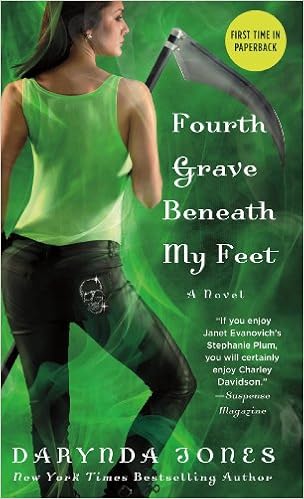
Fourth Grave Beneath My Feet by Darynda Jones


This is the fourth book in the Charley Davidson P.I. series (I suggest starting with the first one, First Grave on the Right, as you'll otherwise be a little lost reading this book).  Charley Davidson's mother died giving birth to her and her father married an evil step-monster a year later who would make Charley's childhood miserable.  She has a sister who is a therapist and her dad, a former cop runs a bar, while her Uncle Bob, still on the force uses Charley's unique abilities to help him solve cases.  Charley is a Grim Reaper.

She can see and talk to ghosts, they can pass through her when they are ready to move on to heaven, and Satan has plans to use her as a gateway to heaven to take over, using his son, Reyes, who has the map out of hell tattooed on his arms.  Reyes has been waiting centuries for someone of Charley's talent to come along and has spent time protecting her when he could.  Reyes, who was innocent, went to prison for killing his very abusive adopted father, but after ten years gets released when new evidence comes to light.  Charley and Reyes have a very sexually charged relationship, even though they have never physically had sex.  Reyes hates Satan and refuses to be a part of his plans and is currently killing off demons possessing people, so they don't get to Charley.

Charley names everything in her life.  Her jeep is named Misery, her breasts are Danger and Will Robinson, her brain in Barbara.  Charley's secretary/partner in crime, Cookie, and her twelve-year-old daughter help with the detective businesses.  This book opens up with a traumatized Charley afraid to go outside of her house after what happened in the third book (Third Grave Dead Ahead).  She spends her time watching the Home Shopping Network and buying multiple things she has no use for.

A new client gets her off the couch.  A woman believes someone has been trying to kill her since she was five-years-old, which is right after her father and new step-monster came back from their honeymoon.  Her step-brother believes her, but her family sends her to multiple shrinks all her life and even lock her up once.  She ran away for three years to get away from it but has now returned home to Albuquerque only to have things like unstuffed rabbits with their throats slit found in her home.  Charley puts her in a safe house, for a while as she figures out what is going on.

While acting tough on the outside, Charley is rather scared in this book due to her past trauma and because of the demons hunting her down trying to kill her.  I can't recommend this series highly enough.  It's full of sarcasm, wit, a hot son of Satan, and a kick ass Grim Reaper who is just now realizing some of the powers she really has.

Quotes


He raised a flashlight and scanned Misery’s ‘[her car] innards.  Sadly, all he’d find was a mishmash of files, a couple of jackets, and basic survival gear that consisted mainly of Cheez-Its and an emergency stash of Thin Mints.  Frickin’ Girl Scouts.  Those things were way too addictive.  They had to be laced with crack.
---Darynda Jones (Fourth Grave Beneath My Feet p 56)


Why kill them with kindness when you can use an axe?
--Darynda Jones (Fourth Grave Beneath My Feet p 73)


Insanity does NOT run in my family.  It strolls through, takes its time, and gets to know everyone personally.
-- Darynda Jones (Fourth Grave Beneath My Feet p 101)


When I want your opinion, I’ll remove the duct tape.
Darynda Jones (Fourth Grave Beneath My Feet p 168)


Drink coffee!  Do stupid things faster and with more energy.
--Darynda Jones (Fourth Grave Beneath My Feet p 180)


Don’t judge me because I’m quiet.  No one plans a murder out loud.
--Darynda Jones (Fourth Grave Beneath My Feet p 232)


That which doesn’t kill me had better run pretty darned fast.
--Darynda Jones (Fourth Grave Beneath My Feet p 258)
Link to Amazon:  https://www.amazon.com/Fourth-Grave-Beneath-Charley-Davidson/dp/1250025370/ref=sr_1_1?ie=UTF8&qid=1477313457&sr=8-1&keywords=fourth+grave+beneath+my+feet+by+darynda+jones


Sunday, October 23, 2016

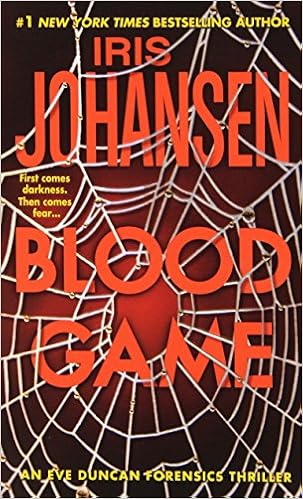
Blood Game By Iris Johansen


Eve Duncan is a forensic sculptor who reconstructs skulls in the hopes of bringing bodies back to their families, always looking for her daughter who went missing and is presumed dead, years ago.  Joe Quinn, the FBI agent assigned to the case would eventually marry her and join the Atlanta Police Department.  While they would work together to put killers behind bars, the ultimate goal is to find Bonnie.  Jane, now an adult, was a young girl that they adopted from the streets who helps them.

In this book, a psychotic killer believes that if he drinks a certain number of the blood of strong, intelligent women, he will have god-like powers.  Nancy Joe, a senator's daughter, is the first kill.  Her throat is slit and a cup with ancient symbols on it is found at the scene, where the killer drank her blood.  Another cup is found in Eve's fridge.  This killer plans on making Eve his final victim.

Megan, a former ER doctor, who had to give up her practice due to her gifts, one of which is the ability to hear the words of the dying where they were killed and the other is to, if she is emotionally charged, to touch someone and unlock their own psychic gift.  She has done this to Joe, who is now seeing ghosts, even if he does not want to accept it.  Megan belongs to a large family of those with special powers, so she calls upon them to help.  When they see the picture of the cup, they contact Seth Caleb, who has been hunting down the cult and wants to eliminate the one remaining.

Seth heads to Atlanta to help Joe and Eve but is met with resistance as they find it hard to believe in the supernatural.  Eventually, though, they have to believe or risk losing their lives as the killer gets closer and closer.  Seth's ability is to persuade others to do what he asks.  He can not make people do what he wants, but he can be charming.  This killer killed someone he cared deeply about and he intends to end him.

With the help of Nancy Joe and others, the net begins to close in on the killer, who has a few tricks up his own sleeve.  Joe's not sure whether Seth will be a help or a hindrance, but eventually he has to trust him to some degree sometime as the clock is ticking and no one knows where this sadistic killer will strike next, only that Eve and Jane's lives are in danger, as well as anyone close to them.

Link to Amazon:  https://www.amazon.com/Blood-Game-Duncan-Forensics-Thriller/dp/0312368135/ref=sr_1_1?ie=UTF8&qid=1477241828&sr=8-1&keywords=blood+game

Monday, October 17, 2016

The Beautiful Cigar Girl: Mary Rogers, Edgar Allan Poe, and The Invention of Murder by Daniel Stashower


Since this book is partly the history of both Edgar Allan Poe's life and work, which have seen much contradictions and disagreement that one may not be sure as to where the truth may lay, I feel the need to give the author's credentials.  Stashower has won the Edgar Award for best Biography for his work on Sir Arthur Conan Doyle, called Teller of Tales, and the Raymond Chandler Fulbright Fellowship for his work in fiction.  This is a hard book to review because of every word, and every phrase, contains a gem of information so fascinating that I want to share it.  But if I did that, I would be essentially re-writing the book, or at the least, giving away so much information, it would not be worth your while to read it.  If I give too little, you may not become interested enough to read this excellent work.  I do hope I do this book credit.  As a side note, I will mention that I once rode a ride at Disney called Its a Small World After All.  You will feel this way as you read this book as so many familiar names keep cropping up.  It seems too incredible to be true, but I guess it really is a small world.

Let me also set the stage.  This takes place around the year 1841.  At this time the five points gangs are thriving in New York City [think Gangs of New York], there is no police force as we know it.  There are two Justice of the Peace for a certain district and some constables, and nightwatchmen who are made up of retirees who often fall asleep at call boxes and who's only job seems to be to announce the time and the weather.  The firemen would fight each other over who would get to fight the fire and get the spoils.  In 1836 and 1840 there would be runs on the banks and unemployment. It wasn't unheard of for women from nice, even well off, families, to find themselves roofied and wake up no longer a virgin with a family that turns its back on her, forcing her into a life as a high class prostitute.  And the only job for a respectable woman is to open a boarding house.  There are a lot of those in New York City.

The book starts off in 1842 with Poe sending out enquiries to various magazines about writing a sequel to The Murders In Rue Morgue (the story is detailed between pages 113 to the second paragraph of 118, if you haven't read it and want to, skip those pages).  This story "anticipated virtually every convention of what would become the modern mystery story--the brooding, eccentric sleuth; the comparatively dense sidekick; the wrongfully accused suspect; the unlikely villain; the false clue; and--perhaps; above all--the impossible, locked-room crime.  Today the story stands as a literary milestone--the genesis of the entire crime fiction genre--but its original publication drew only scant notice."  It has been a year since the tragic and highly publicized death of Mary Rogers, the "beautiful cigar girl" and no person or persons have been brought forth to be held accountable.  Poe is persuading editors that by using his French detective Dupin and setting it in France, calling it The Mystery of Marie Roget and using facts gleaned from the newspapers and the inquest he can unmask the killer and prod the police to reopen the investigation.

This book does a bit of time traveling.  In various chapters we learn the history of Edgar Allan Poe.  His mother was a talented actress living in Boston who fell in love with a man from a well off family, who was studying to become a lawyer. He gave that up for the stage and married her.  They had three children: Henry, Edgar, and Sophie.  By the time Sophie is born, Poe's father is a drunken, bitter man, who hasn't the talent his wife has and is resentful she makes more than he does.  He deserts the family and dies on the streets shortly thereafter.  Poe's mother dies six months later of tuberculosis.  Henry had already been sent to his father's parents, but when his mother died, they had had a reversal of fortune and could not take in the other two children  who were fostered out.  Poe, at the age of three, ended up with an enterprising merchant and his childless wife, John Allan of Richmond, Virginia.  While he would never adopt Poe, he would give him his name and he doted on him when Poe was young and kept his promise to Poe's family to provide an education for him.  So Poe grew up wanting nothing and receiving a fine education where he thrived.  Unfortunately, when Poe hit his teens, he became a teenager, like any parent can attest to, and he and Allan fought often.  Allan kept his word though and at age sixteen Poe went to the newly built by Thomas Jefferson (with whom he had lunches with months before his death) University of Virginia.  Allan, also chose this time to teach Poe the value of a dollar after lavishing money on him all his life, only sends him about $150 when Poe really needs around $350 for the year to pay for lodging, food, books, supplies, food, etc... He constantly wrote to Allan begging for money to buy books and soap, but Allan would not relent.  Poe turned to gambling to try to get money after he gets turned out of his lodging and is soon in $2000 debt and is forced to leave college.  Before he leaves though, he receives an academic honor from both Madison and Monroe (start singing now).

Poe will be eventually kicked out of the house and join the Army of all things.  He signs up at the age of eighteen, illegally, for five years.  He is actually quite good at it, but after two years he is bored and wants out.  He eventually is able to get out of the Army by getting into West Point where he believes his two years of Army skills will have him graduating from there in six months.  He is quickly abused of that notion.  While his grades are excellent, everything else is not.  [Side note: I have been watching a three part documentary on Jefferson Davis and he was there when Poe was and the two, with others, would sneak off campus to the local saloon and drink, which was against the rules.] Poe decided the only way out was to get kicked out, so he set out to do just that and succeeded. Although, with the financial help of his fellow cadets who loved him, he was able to publish his first book of verse, which, of course, was not a success.

Eventually Poe ends up in Baltimore where he meets his beautiful Virginia, whom he would marry at the age of fourteen, but not become "her husband" until she turned sixteen.  They lived with her mother, Maria Clemm.  Poe would move them to Richmond, where he would begin his rather successful career as a reviewer for Thomas White's magazine.  He was an excellent judge of writing and could accurately pin point the good and bad of the piece.  The problem was that Poe had a tendency to eviscerate the writing and the writer to the point that he quickly made quite a few enemies that he would have his whole life.  He would become angry that his talent wasn't monetarily appreciated, as the magazine made a lot of money off of his work, so he quit and moved to New York City and then Pennsylvania.  During this time, Virginia would come down with tuberculosis. Poe's love for his wife and his distress over her illness would inspire such works as "The Masque of the Red Death" and "Eleonora".

It is in Pennsylvania in 1840, while working for a magazine by a man named Burton, who ill treats him, that the magazine is sold to a man, Graham, that will treat Poe well, and will be one of the few people Poe will never speak ill of.  Graham, is an excellent editor and picks some of the best offerings of the day.  He also pays Poe the nicest he has seen so far, if still not a great one, and promises him light duties so he can work on his writings, and that he will help Poe achieve his dream of starting his own literary magazine.  Sadly, Graham, would "conveniently forget" his promise to Poe, when Poe's work begins to bring in an enormous amount of money for the magazine.  Poe becomes angry, as he so often does, and either quits, or gets fired.  It is at this time that he hears and follows the story in the papers of the murder of Mary Rogers.

Mary Rogers, born in 1820, was from two prominent Connecticut families: the Rogers and the Mathers [Yes, those, Increase and Cotton, continue singing].  Her mother, Phoebe Rogers, married Ezra Mathers and had four sons and one daughter. He would die suddenly, but he left her with enough money to live rather comfortably until she remarried.  Six years later, though she would marry Daniel Rogers, a man eleven years younger than herself, with a thriving shipping business.  Mary is supposed to be a product of that union, but some believe that Mary is actually the illegitimate daughter of Phoebe's daughter from her first marriage.  It was a common thing for a mother to claim an unwed daughter's child as her own.  Nonetheless, eventually, all five of the children and her husband would die from illness and other tragedies.  So Phoebe and Mary would head to New York where her sister lived.  They would stay at first with John Anderson, the tobacconist, whose shop Mary would eventually spend time working in for a while.  No reason is given why they stay with him, only that when he hires Mary he promises that she will never be alone in the store and he will walk her home every night.  This is in 1838.

Mary becomes quite popular.  She knows just how much to flirt and quickly Anderson's shop is doing a brisk business and becomes the place for politicians and newsmen to hang out together and talk shop off the record and those of the literary circle to rub elbows.  It is even said that Poe was seen there.  One day, Anderson is in the back of the shop, and when he comes back to the front, Mary is gone,  Her mother shows up frantic with a letter supposed to be written by Mary that sounds like a suicide note.  A search is quickly set up, but a general consensus of newspaper accounts, she was back a few hours later, with no real explanation as to where she had gone.  Not long after that Phoebe comes into some money and opens up, yes, a boarding house, so Mary goes to help her mother run it.

At this boarding house Mary would form a very close relationship with Alfred Crommelin, a man comfortably off, who cared deeply about her.  She would eventually throw him over for the n'er do well cork cutter, Daniel Payne, who was seen as a drunkard.  Soon, Payne comes to think of himself as Mary's fiancée and Crommelin finds himself in the position of kindly uncle.  By June of 1841, one evening Crommelin found Mary and Daniel in "unseemly intimacies" in the front parlor.  After lecturing Payne on the duties of a gentleman and getting laughed at and told to mind his own his business, he tells Mary that he will always be there for her, but he would no longer be staying there.

On the morning of Sunday, July 25, 1841, at ten o'clock, Mary stops at Daniel's door to tell him that she is going to visit her aunt for the day and will be back in the evening and will be at the corner of Broadway and Ann for him to escort her home.  That night a storm comes down and Daniel believes that Mary would have stayed at her aunt's instead of going out in the storm.  Daniel forgot that the bus she would have taken to her aunt's doesn't run on Sundays.  The next day, it will be discovered that she is missing.  Daniel begins to search all over town.  Eventually others are called in to help, as most people still remember Mary from her days as the cigar girl.  Three days later, Crommelin says the reason he goes to Hoboken, New Jersey is that he worries that Mary might be in a house of ill repute.

New Yorkers (at that time at least) went there to visit the beautiful park, Elysian Fields, where couples strolled, you could buy refreshments, take a boat ride, and where the in 1846 the first official professional baseball game is played. Two men walking along the banks of the Hudson see a body floating in the Hudson.  They get in a boat and use an oar to drag it to the bank, then leave.  Some other people see this and drag the girl onto shore.  Among this group is Crommelin, who rushes forth and identifies the body as Mary from the distinctive hair markings on her arm and her delicate feet.  Her face is battered and I don't need to tell you what three days in the water can do to a body.  The Justice of the Peace is called for, but it takes him a long while to get there, leaving the body to decompose even more in the incredibly hot sun over hours.

Oddly enough, the city of New York had an excellent coroner, Dr. Cook, who would overrule the Justice of the Peace and rule it murder, because he can tell that it is not a drowning.  During his autopsy he discovers that a piece of her skirt has been torn off and used to strangle her. There are also hand prints around her neck.  Her hat seems to have been taken off at some point and retied with a "sailor's knot" after her death.  Another piece of cloth from her skirts was used to drag her body from the kill site to the river.  When he examines her vaginally he determines that she had been violated by two to three men prior to her death and forcibly held down on a hard surface.

Mary's body will then be buried in two feet of soil so she can be preserved for future examination.  Then another two weeks will go by while New York and New Jersey both try to get out of having to investigate the murder.  At this time, you had to provide money as a reward in order to proceed with a case and no one wanted to spend anything.

This is where the "father of yellow journalism" James Gordon Bennett comes in.  He started out with little and began a penny press, the Herald, that quickly grew and made lots of money.  He also became the enemy of all the other newspapers.  One hit him so hard with his riding crop that it broke.  Bennett just smiled and handed it back to him. Another man forced his jaws open and spat down his throat.  Bennett preferred to get his revenge in print.  At this time, as now, each paper had its own agenda and often attacked each other.  Bennett was the best.  He was the one to make the death of Mary Rogers a front page story that would captivate America.  He also was pushing for police reform, so he ended the stalemate by drumming up reward money from editors and prominent citizens.  The governor of New York, William Seward [Yes, that one, sing on] gives more money for a reward and eventually offers immunity to any parties involved who did not commit the act, but can provide information.

For a while things are a flurry of activity.  Many people and theories abound.  Then in October someone connected dies and Dr. Cook who was slaughtered in the press for his testimony at the inquest, is vague on the details of the death and refuses to give a cause of death.  Then the grisly ax murder of Sam Adams [not that one] by John C. Colt, brother of [wait for it] the gun manufacturer, kicks Mary Rogers off the pages of the newspaper and she is forgotten. Until Poe comes along.

Poe convinces a magazine to print his story in three parts. Two days before the last installment of the third piece the slap in the face in a fictional mystery story happens.  The one where the reader goes "I didn't see that coming".  Then, "but what about...".   Now, Poe is in a difficult situation.  He has spent two parts of the story setting up the ending, which if he publishes now, will make him a laughing stock, as well as his original use of ratiocination (deductive reasoning--hello Sherlock and Poirot!).  His editor gives him an extra month to come up with something to salvage the story.  The question is, can he?  Does he really know who the murderer is?  Poe was quite well known for figuring out puzzles, including a famous Turkish chess playing machine that fooled the world.  It is possible.

I will end my tale here.  I will say that Poe's life is a sad one.  While the author does not address whether Poe was mad or not, I will offer my armchair analysis and say it is possible that he was a manic depressive.  He was sometimes described as melancholy and a loner or excitable and having nervous energy.  He also flew into infamous rages and felt slights rather easily.  Sadly he was incredibly self-destructive his whole life and often self-medicated with alcohol.  He had a zero tolerance.  A glass of weak wine or a beer would have him drunk and he never stopped at that.  It may be because of these things that he was never truly appreciated in his time.  It would be the Europeans in the late nineteenth century, such as Nietzsche, Kafka, Baudelaire, Rilke, and Doyle, whom he would influence all the way through to modern times.  The conflicting and bad things said about him are explained at the end of this book and it is rather sad.  Interestingly, Mary Rogers has largely been forgotten, unless you've lived around New York City for a while, where the memories of such "crimes of the centuries" are still remembered, but Poe is so remembered that even a professional football team is named after his most famous poem, "The Raven".  This is a remarkable book and well worth reading and as it is close to Halloween, rather appropriate.  I think Poe would approve.

Quotes:
 The proprietor…preferred to deal with “readers of serious intent” rather than common browsers, and it was known in the neighborhood that “freedom of Gowan’s bookstore was not presented to every passer-by”. The chosen few who gained admittance found a massive but haphazard inventory, ranging from rare texts on Greek horology and Roman funerary practices to the latest European novels. Gowans opened the shop in January of 1837 and soon filled the floor-to-ceiling oak plank shelves to capacity.  As additional volumes accumulated they were stored first in wooden crates stacked on a pair of battered deal tables, then on chairs scavenged from a previous tenant, and finally in teetering stacks on the floor.  The impressive created, recalled one early visitor, was that of a “Minotaur maze of books.”

--Daniel Stashhower (The Beautiful Cigar Girl: Mary Rogers, Edgar Allan Poe, and The Invention of Murder p 31)
 “I think,” Poe once wrote… “that I have already had my share of trouble for one so young.” It was once of the few occasions where he might have been accused of understatement

-- Daniel Stashhower (The Beautiful Cigar Girl: Mary Rogers, Edgar Allan Poe, and The Invention of Murder p 34)
 …Edgar and his newborn sister spent much of their time in the care of nursemaids, one of whom, according to a family friend, “fed them liberally with bread soaked in gin” and “freely administered…other spirituous liquors, with sometimes laudanum.” This, the nurse believed, would “make them strong and healthy.”

-- Daniel Stashhower (The Beautiful Cigar Girl: Mary Rogers, Edgar Allan Poe, and The Invention of Murder p 35)


If three more years in the army had seemed intolerable, four years at West Point was the stuff of nightmares.
-- Daniel Stashhower (The Beautiful Cigar Girl: Mary Rogers, Edgar Allan Poe, and The Invention of Murder p 48)
Link to Amazon:  https://www.amazon.com/Beautiful-Cigar-Girl-Rogers-Invention/dp/0425217825/ref=sr_1_1?s=books&ie=UTF8&qid=1476711789&sr=1-1&keywords=the+beautiful+cigar+girl
 

Sunday, October 16, 2016

The Passion of the Purple Plumeria by Lauren Willig


For those who read the Pink Carnation series, this is one that came out last year and I missed it.  If you do read the Pink Carnation series and haven't read this one, then you must, as it is finally the story of Miss Gwen Meadows, the chaperon of Jane Wolister, the Pink Carnation, herself, in France.  Gwen is considered a dragon lady of a spinster at forty-five; always with her pointy parasol that hides a sword within.  She swings from rooftops and hides in dark alleys, always looking for information to help the English cause in the Napoleonic War against France.

When Jane's sister, Agnes, and her roommate, Lizzy Reid, go missing at their private school, Gwen and Jane hurry back to England to find them.  There they are greeted by the handsome and charming Cololnel Reid of the East India Company, who is the father of Lizzy, who is a bastard born from a relationship he had with an Indian woman.  He sent Lizzy and her sister away to England ten years ago for their protection, as things in India were not safe for young women, especially those not born to English parents.  Now he's come back to find a house for them and settle down, when he learns that Lizzy is gone and his other daughter has not been truthful about the circumstances of her life with her mother's mother.

After discovering that the girls are not in Brighton, with Lizzy's sister, Reid gets set upon by a set of footpads, that he and Gwen manage to fight off, but not before Reid gets stabbed.  They stay for five intimate days in an inn, where Gwen patches him up and Reid has fevered dreams and kisses her.  Once he is well, they return to Bath, where the school is, and discover that the girls have gone to Selwick Hall, to visit Agnes's cousin Amy, possibly because they have a set of jewels that were once owned by a sultan of Berar.  One of which is said to have mystical powers.  These jewels were stolen by Jack, one of Reid's sons and sent to Lizzy for safekeeping.

The other story that goes with these books is that of grad student, Eloise, who has been researching the Pink Carnation for her dissertation. Through her research, she meets Colin Selwick and they begin dating.  She has essentially moved into Selwick Hall, after her grant ended.  She is supposed to go back to the States in two months for a teaching job and is dreading it.  Having hit a road block in her studies (she can find nothing about the Pink Carnation after April 1805), she decides to help Colin look for the family treasure: the famed treasure of Berar.  When they go to his great aunt for help, his evil cousin/step-father Jeremy is there for the same reason.  His great aunt intimates that she doesn't have long to live and that she would like the two of them to bury the hatchet and find peace.  She does this by giving them information on where the treasure could be hidden, but only if they work together.   So while everyone in 1805 England is looking for the treasure of Berar, as well as the two girls, who may have it, a very modern hunt is going on in Selwick Hall.

Reid and Gwen are a perfect match, even if she doesn't want to see it.  She feels she is too old for this nonsense and she loves the thrill of being a spy so much, she doesn't want to give it up.  However, this may not be her decision to make, as the Pink Carnation, Jane, has been keeping things from Gwen, such as the identity of the Gardner, the ultimate French spy, and what her plans are after the girls are found.   Can Gwen give up her old life and "settle down" with a retired Colonel, as much as the two could possibly settle down, and finish the gothic novel she has been writing?  This book was everything and more.  It was quite satisfying to see Gwen find someone as strong as she is both in wit and daring, to be with, when, I have, quite frankly, thought she'd never be a character to have a story of her own.  I, too, thought she was too old and was too tied in with Jane and the Pink Carnation to have a life of her own.  I have to say I was pleasantly surprised and very happy with the result.

Quotes:


Things turn up in strange places all the time… For example, library books, which possess a disconcerting ability to move from place to place, seemingly of their own volition.
--Lauren Willig (The Passion of the Purple Plumeria p 10)
 It was the rankest effrontery on your part to get yourself stabbed.

---Lauran Willig (The Passion of the Purple Plumeria p 127)
Link to Amazon:  https://www.amazon.com/Passion-Purple-Plumeria-Carnation-Novel/dp/0451414721/ref=sr_1_1?ie=UTF8&qid=1476640850&sr=8-1&keywords=the+passion+of+the+purple+plumeria