I do not think that there can ever be enough books about anything and I say that knowing that some of them are going to be about Pilates.The more knowledge the better seems like a solid rule of thumb, even though I have watched enough science fiction films to accept that humanity’s unchecked pursuit of learning will end with robots taking over the world.-Sarah Vowell

Sunday, October 23, 2016

Blood Game By Iris Johansen


Eve Duncan is a forensic sculptor who reconstructs skulls in the hopes of bringing bodies back to their families, always looking for her daughter who went missing and is presumed dead, years ago.  Joe Quinn, the FBI agent assigned to the case would eventually marry her and join the Atlanta Police Department.  While they would work together to put killers behind bars, the ultimate goal is to find Bonnie.  Jane, now an adult, was a young girl that they adopted from the streets who helps them.

In this book, a psychotic killer believes that if he drinks a certain number of the blood of strong, intelligent women, he will have god-like powers.  Nancy Joe, a senator's daughter, is the first kill.  Her throat is slit and a cup with ancient symbols on it is found at the scene, where the killer drank her blood.  Another cup is found in Eve's fridge.  This killer plans on making Eve his final victim.

Megan, a former ER doctor, who had to give up her practice due to her gifts, one of which is the ability to hear the words of the dying where they were killed and the other is to, if she is emotionally charged, to touch someone and unlock their own psychic gift.  She has done this to Joe, who is now seeing ghosts, even if he does not want to accept it.  Megan belongs to a large family of those with special powers, so she calls upon them to help.  When they see the picture of the cup, they contact Seth Caleb, who has been hunting down the cult and wants to eliminate the one remaining.

Seth heads to Atlanta to help Joe and Eve but is met with resistance as they find it hard to believe in the supernatural.  Eventually, though, they have to believe or risk losing their lives as the killer gets closer and closer.  Seth's ability is to persuade others to do what he asks.  He can not make people do what he wants, but he can be charming.  This killer killed someone he cared deeply about and he intends to end him.

With the help of Nancy Joe and others, the net begins to close in on the killer, who has a few tricks up his own sleeve.  Joe's not sure whether Seth will be a help or a hindrance, but eventually he has to trust him to some degree sometime as the clock is ticking and no one knows where this sadistic killer will strike next, only that Eve and Jane's lives are in danger, as well as anyone close to them.

Link to Amazon:  https://www.amazon.com/Blood-Game-Duncan-Forensics-Thriller/dp/0312368135/ref=sr_1_1?ie=UTF8&qid=1477241828&sr=8-1&keywords=blood+game

Monday, October 17, 2016

The Beautiful Cigar Girl: Mary Rogers, Edgar Allan Poe, and The Invention of Murder by Daniel Stashower


Since this book is partly the history of both Edgar Allan Poe's life and work, which have seen much contradictions and disagreement that one may not be sure as to where the truth may lay, I feel the need to give the author's credentials.  Stashower has won the Edgar Award for best Biography for his work on Sir Arthur Conan Doyle, called Teller of Tales, and the Raymond Chandler Fulbright Fellowship for his work in fiction.  This is a hard book to review because of every word, and every phrase, contains a gem of information so fascinating that I want to share it.  But if I did that, I would be essentially re-writing the book, or at the least, giving away so much information, it would not be worth your while to read it.  If I give too little, you may not become interested enough to read this excellent work.  I do hope I do this book credit.  As a side note, I will mention that I once rode a ride at Disney called Its a Small World After All.  You will feel this way as you read this book as so many familiar names keep cropping up.  It seems too incredible to be true, but I guess it really is a small world.

Let me also set the stage.  This takes place around the year 1841.  At this time the five points gangs are thriving in New York City [think Gangs of New York], there is no police force as we know it.  There are two Justice of the Peace for a certain district and some constables, and nightwatchmen who are made up of retirees who often fall asleep at call boxes and who's only job seems to be to announce the time and the weather.  The firemen would fight each other over who would get to fight the fire and get the spoils.  In 1836 and 1840 there would be runs on the banks and unemployment. It wasn't unheard of for women from nice, even well off, families, to find themselves roofied and wake up no longer a virgin with a family that turns its back on her, forcing her into a life as a high class prostitute.  And the only job for a respectable woman is to open a boarding house.  There are a lot of those in New York City.

The book starts off in 1842 with Poe sending out enquiries to various magazines about writing a sequel to The Murders In Rue Morgue (the story is detailed between pages 113 to the second paragraph of 118, if you haven't read it and want to, skip those pages).  This story "anticipated virtually every convention of what would become the modern mystery story--the brooding, eccentric sleuth; the comparatively dense sidekick; the wrongfully accused suspect; the unlikely villain; the false clue; and--perhaps; above all--the impossible, locked-room crime.  Today the story stands as a literary milestone--the genesis of the entire crime fiction genre--but its original publication drew only scant notice."  It has been a year since the tragic and highly publicized death of Mary Rogers, the "beautiful cigar girl" and no person or persons have been brought forth to be held accountable.  Poe is persuading editors that by using his French detective Dupin and setting it in France, calling it The Mystery of Marie Roget and using facts gleaned from the newspapers and the inquest he can unmask the killer and prod the police to reopen the investigation.

This book does a bit of time traveling.  In various chapters we learn the history of Edgar Allan Poe.  His mother was a talented actress living in Boston who fell in love with a man from a well off family, who was studying to become a lawyer. He gave that up for the stage and married her.  They had three children: Henry, Edgar, and Sophie.  By the time Sophie is born, Poe's father is a drunken, bitter man, who hasn't the talent his wife has and is resentful she makes more than he does.  He deserts the family and dies on the streets shortly thereafter.  Poe's mother dies six months later of tuberculosis.  Henry had already been sent to his father's parents, but when his mother died, they had had a reversal of fortune and could not take in the other two children  who were fostered out.  Poe, at the age of three, ended up with an enterprising merchant and his childless wife, John Allan of Richmond, Virginia.  While he would never adopt Poe, he would give him his name and he doted on him when Poe was young and kept his promise to Poe's family to provide an education for him.  So Poe grew up wanting nothing and receiving a fine education where he thrived.  Unfortunately, when Poe hit his teens, he became a teenager, like any parent can attest to, and he and Allan fought often.  Allan kept his word though and at age sixteen Poe went to the newly built by Thomas Jefferson (with whom he had lunches with months before his death) University of Virginia.  Allan, also chose this time to teach Poe the value of a dollar after lavishing money on him all his life, only sends him about $150 when Poe really needs around $350 for the year to pay for lodging, food, books, supplies, food, etc... He constantly wrote to Allan begging for money to buy books and soap, but Allan would not relent.  Poe turned to gambling to try to get money after he gets turned out of his lodging and is soon in $2000 debt and is forced to leave college.  Before he leaves though, he receives an academic honor from both Madison and Monroe (start singing now).

Poe will be eventually kicked out of the house and join the Army of all things.  He signs up at the age of eighteen, illegally, for five years.  He is actually quite good at it, but after two years he is bored and wants out.  He eventually is able to get out of the Army by getting into West Point where he believes his two years of Army skills will have him graduating from there in six months.  He is quickly abused of that notion.  While his grades are excellent, everything else is not.  [Side note: I have been watching a three part documentary on Jefferson Davis and he was there when Poe was and the two, with others, would sneak off campus to the local saloon and drink, which was against the rules.] Poe decided the only way out was to get kicked out, so he set out to do just that and succeeded. Although, with the financial help of his fellow cadets who loved him, he was able to publish his first book of verse, which, of course, was not a success.

Eventually Poe ends up in Baltimore where he meets his beautiful Virginia, whom he would marry at the age of fourteen, but not become "her husband" until she turned sixteen.  They lived with her mother, Maria Clemm.  Poe would move them to Richmond, where he would begin his rather successful career as a reviewer for Thomas White's magazine.  He was an excellent judge of writing and could accurately pin point the good and bad of the piece.  The problem was that Poe had a tendency to eviscerate the writing and the writer to the point that he quickly made quite a few enemies that he would have his whole life.  He would become angry that his talent wasn't monetarily appreciated, as the magazine made a lot of money off of his work, so he quit and moved to New York City and then Pennsylvania.  During this time, Virginia would come down with tuberculosis. Poe's love for his wife and his distress over her illness would inspire such works as "The Masque of the Red Death" and "Eleonora".

It is in Pennsylvania in 1840, while working for a magazine by a man named Burton, who ill treats him, that the magazine is sold to a man, Graham, that will treat Poe well, and will be one of the few people Poe will never speak ill of.  Graham, is an excellent editor and picks some of the best offerings of the day.  He also pays Poe the nicest he has seen so far, if still not a great one, and promises him light duties so he can work on his writings, and that he will help Poe achieve his dream of starting his own literary magazine.  Sadly, Graham, would "conveniently forget" his promise to Poe, when Poe's work begins to bring in an enormous amount of money for the magazine.  Poe becomes angry, as he so often does, and either quits, or gets fired.  It is at this time that he hears and follows the story in the papers of the murder of Mary Rogers.

Mary Rogers, born in 1820, was from two prominent Connecticut families: the Rogers and the Mathers [Yes, those, Increase and Cotton, continue singing].  Her mother, Phoebe Rogers, married Ezra Mathers and had four sons and one daughter. He would die suddenly, but he left her with enough money to live rather comfortably until she remarried.  Six years later, though she would marry Daniel Rogers, a man eleven years younger than herself, with a thriving shipping business.  Mary is supposed to be a product of that union, but some believe that Mary is actually the illegitimate daughter of Phoebe's daughter from her first marriage.  It was a common thing for a mother to claim an unwed daughter's child as her own.  Nonetheless, eventually, all five of the children and her husband would die from illness and other tragedies.  So Phoebe and Mary would head to New York where her sister lived.  They would stay at first with John Anderson, the tobacconist, whose shop Mary would eventually spend time working in for a while.  No reason is given why they stay with him, only that when he hires Mary he promises that she will never be alone in the store and he will walk her home every night.  This is in 1838.

Mary becomes quite popular.  She knows just how much to flirt and quickly Anderson's shop is doing a brisk business and becomes the place for politicians and newsmen to hang out together and talk shop off the record and those of the literary circle to rub elbows.  It is even said that Poe was seen there.  One day, Anderson is in the back of the shop, and when he comes back to the front, Mary is gone,  Her mother shows up frantic with a letter supposed to be written by Mary that sounds like a suicide note.  A search is quickly set up, but a general consensus of newspaper accounts, she was back a few hours later, with no real explanation as to where she had gone.  Not long after that Phoebe comes into some money and opens up, yes, a boarding house, so Mary goes to help her mother run it.

At this boarding house Mary would form a very close relationship with Alfred Crommelin, a man comfortably off, who cared deeply about her.  She would eventually throw him over for the n'er do well cork cutter, Daniel Payne, who was seen as a drunkard.  Soon, Payne comes to think of himself as Mary's fiancĂ©e and Crommelin finds himself in the position of kindly uncle.  By June of 1841, one evening Crommelin found Mary and Daniel in "unseemly intimacies" in the front parlor.  After lecturing Payne on the duties of a gentleman and getting laughed at and told to mind his own his business, he tells Mary that he will always be there for her, but he would no longer be staying there.

On the morning of Sunday, July 25, 1841, at ten o'clock, Mary stops at Daniel's door to tell him that she is going to visit her aunt for the day and will be back in the evening and will be at the corner of Broadway and Ann for him to escort her home.  That night a storm comes down and Daniel believes that Mary would have stayed at her aunt's instead of going out in the storm.  Daniel forgot that the bus she would have taken to her aunt's doesn't run on Sundays.  The next day, it will be discovered that she is missing.  Daniel begins to search all over town.  Eventually others are called in to help, as most people still remember Mary from her days as the cigar girl.  Three days later, Crommelin says the reason he goes to Hoboken, New Jersey is that he worries that Mary might be in a house of ill repute.

New Yorkers (at that time at least) went there to visit the beautiful park, Elysian Fields, where couples strolled, you could buy refreshments, take a boat ride, and where the in 1846 the first official professional baseball game is played. Two men walking along the banks of the Hudson see a body floating in the Hudson.  They get in a boat and use an oar to drag it to the bank, then leave.  Some other people see this and drag the girl onto shore.  Among this group is Crommelin, who rushes forth and identifies the body as Mary from the distinctive hair markings on her arm and her delicate feet.  Her face is battered and I don't need to tell you what three days in the water can do to a body.  The Justice of the Peace is called for, but it takes him a long while to get there, leaving the body to decompose even more in the incredibly hot sun over hours.

Oddly enough, the city of New York had an excellent coroner, Dr. Cook, who would overrule the Justice of the Peace and rule it murder, because he can tell that it is not a drowning.  During his autopsy he discovers that a piece of her skirt has been torn off and used to strangle her. There are also hand prints around her neck.  Her hat seems to have been taken off at some point and retied with a "sailor's knot" after her death.  Another piece of cloth from her skirts was used to drag her body from the kill site to the river.  When he examines her vaginally he determines that she had been violated by two to three men prior to her death and forcibly held down on a hard surface.

Mary's body will then be buried in two feet of soil so she can be preserved for future examination.  Then another two weeks will go by while New York and New Jersey both try to get out of having to investigate the murder.  At this time, you had to provide money as a reward in order to proceed with a case and no one wanted to spend anything.

This is where the "father of yellow journalism" James Gordon Bennett comes in.  He started out with little and began a penny press, the Herald, that quickly grew and made lots of money.  He also became the enemy of all the other newspapers.  One hit him so hard with his riding crop that it broke.  Bennett just smiled and handed it back to him. Another man forced his jaws open and spat down his throat.  Bennett preferred to get his revenge in print.  At this time, as now, each paper had its own agenda and often attacked each other.  Bennett was the best.  He was the one to make the death of Mary Rogers a front page story that would captivate America.  He also was pushing for police reform, so he ended the stalemate by drumming up reward money from editors and prominent citizens.  The governor of New York, William Seward [Yes, that one, sing on] gives more money for a reward and eventually offers immunity to any parties involved who did not commit the act, but can provide information.

For a while things are a flurry of activity.  Many people and theories abound.  Then in October someone connected dies and Dr. Cook who was slaughtered in the press for his testimony at the inquest, is vague on the details of the death and refuses to give a cause of death.  Then the grisly ax murder of Sam Adams [not that one] by John C. Colt, brother of [wait for it] the gun manufacturer, kicks Mary Rogers off the pages of the newspaper and she is forgotten. Until Poe comes along.

Poe convinces a magazine to print his story in three parts. Two days before the last installment of the third piece the slap in the face in a fictional mystery story happens.  The one where the reader goes "I didn't see that coming".  Then, "but what about...".   Now, Poe is in a difficult situation.  He has spent two parts of the story setting up the ending, which if he publishes now, will make him a laughing stock, as well as his original use of ratiocination (deductive reasoning--hello Sherlock and Poirot!).  His editor gives him an extra month to come up with something to salvage the story.  The question is, can he?  Does he really know who the murderer is?  Poe was quite well known for figuring out puzzles, including a famous Turkish chess playing machine that fooled the world.  It is possible.

I will end my tale here.  I will say that Poe's life is a sad one.  While the author does not address whether Poe was mad or not, I will offer my armchair analysis and say it is possible that he was a manic depressive.  He was sometimes described as melancholy and a loner or excitable and having nervous energy.  He also flew into infamous rages and felt slights rather easily.  Sadly he was incredibly self-destructive his whole life and often self-medicated with alcohol.  He had a zero tolerance.  A glass of weak wine or a beer would have him drunk and he never stopped at that.  It may be because of these things that he was never truly appreciated in his time.  It would be the Europeans in the late nineteenth century, such as Nietzsche, Kafka, Baudelaire, Rilke, and Doyle, whom he would influence all the way through to modern times.  The conflicting and bad things said about him are explained at the end of this book and it is rather sad.  Interestingly, Mary Rogers has largely been forgotten, unless you've lived around New York City for a while, where the memories of such "crimes of the centuries" are still remembered, but Poe is so remembered that even a professional football team is named after his most famous poem, "The Raven".  This is a remarkable book and well worth reading and as it is close to Halloween, rather appropriate.  I think Poe would approve.

Quotes:
 The proprietor…preferred to deal with “readers of serious intent” rather than common browsers, and it was known in the neighborhood that “freedom of Gowan’s bookstore was not presented to every passer-by”. The chosen few who gained admittance found a massive but haphazard inventory, ranging from rare texts on Greek horology and Roman funerary practices to the latest European novels. Gowans opened the shop in January of 1837 and soon filled the floor-to-ceiling oak plank shelves to capacity.  As additional volumes accumulated they were stored first in wooden crates stacked on a pair of battered deal tables, then on chairs scavenged from a previous tenant, and finally in teetering stacks on the floor.  The impressive created, recalled one early visitor, was that of a “Minotaur maze of books.”

--Daniel Stashhower (The Beautiful Cigar Girl: Mary Rogers, Edgar Allan Poe, and The Invention of Murder p 31)
 “I think,” Poe once wrote… “that I have already had my share of trouble for one so young.” It was once of the few occasions where he might have been accused of understatement

-- Daniel Stashhower (The Beautiful Cigar Girl: Mary Rogers, Edgar Allan Poe, and The Invention of Murder p 34)
 …Edgar and his newborn sister spent much of their time in the care of nursemaids, one of whom, according to a family friend, “fed them liberally with bread soaked in gin” and “freely administered…other spirituous liquors, with sometimes laudanum.” This, the nurse believed, would “make them strong and healthy.”

-- Daniel Stashhower (The Beautiful Cigar Girl: Mary Rogers, Edgar Allan Poe, and The Invention of Murder p 35)


If three more years in the army had seemed intolerable, four years at West Point was the stuff of nightmares.
-- Daniel Stashhower (The Beautiful Cigar Girl: Mary Rogers, Edgar Allan Poe, and The Invention of Murder p 48)
Link to Amazon:  https://www.amazon.com/Beautiful-Cigar-Girl-Rogers-Invention/dp/0425217825/ref=sr_1_1?s=books&ie=UTF8&qid=1476711789&sr=1-1&keywords=the+beautiful+cigar+girl
 

Sunday, October 16, 2016

The Passion of the Purple Plumeria by Lauren Willig


For those who read the Pink Carnation series, this is one that came out last year and I missed it.  If you do read the Pink Carnation series and haven't read this one, then you must, as it is finally the story of Miss Gwen Meadows, the chaperon of Jane Wolister, the Pink Carnation, herself, in France.  Gwen is considered a dragon lady of a spinster at forty-five; always with her pointy parasol that hides a sword within.  She swings from rooftops and hides in dark alleys, always looking for information to help the English cause in the Napoleonic War against France.

When Jane's sister, Agnes, and her roommate, Lizzy Reid, go missing at their private school, Gwen and Jane hurry back to England to find them.  There they are greeted by the handsome and charming Cololnel Reid of the East India Company, who is the father of Lizzy, who is a bastard born from a relationship he had with an Indian woman.  He sent Lizzy and her sister away to England ten years ago for their protection, as things in India were not safe for young women, especially those not born to English parents.  Now he's come back to find a house for them and settle down, when he learns that Lizzy is gone and his other daughter has not been truthful about the circumstances of her life with her mother's mother.

After discovering that the girls are not in Brighton, with Lizzy's sister, Reid gets set upon by a set of footpads, that he and Gwen manage to fight off, but not before Reid gets stabbed.  They stay for five intimate days in an inn, where Gwen patches him up and Reid has fevered dreams and kisses her.  Once he is well, they return to Bath, where the school is, and discover that the girls have gone to Selwick Hall, to visit Agnes's cousin Amy, possibly because they have a set of jewels that were once owned by a sultan of Berar.  One of which is said to have mystical powers.  These jewels were stolen by Jack, one of Reid's sons and sent to Lizzy for safekeeping.

The other story that goes with these books is that of grad student, Eloise, who has been researching the Pink Carnation for her dissertation. Through her research, she meets Colin Selwick and they begin dating.  She has essentially moved into Selwick Hall, after her grant ended.  She is supposed to go back to the States in two months for a teaching job and is dreading it.  Having hit a road block in her studies (she can find nothing about the Pink Carnation after April 1805), she decides to help Colin look for the family treasure: the famed treasure of Berar.  When they go to his great aunt for help, his evil cousin/step-father Jeremy is there for the same reason.  His great aunt intimates that she doesn't have long to live and that she would like the two of them to bury the hatchet and find peace.  She does this by giving them information on where the treasure could be hidden, but only if they work together.   So while everyone in 1805 England is looking for the treasure of Berar, as well as the two girls, who may have it, a very modern hunt is going on in Selwick Hall.

Reid and Gwen are a perfect match, even if she doesn't want to see it.  She feels she is too old for this nonsense and she loves the thrill of being a spy so much, she doesn't want to give it up.  However, this may not be her decision to make, as the Pink Carnation, Jane, has been keeping things from Gwen, such as the identity of the Gardner, the ultimate French spy, and what her plans are after the girls are found.   Can Gwen give up her old life and "settle down" with a retired Colonel, as much as the two could possibly settle down, and finish the gothic novel she has been writing?  This book was everything and more.  It was quite satisfying to see Gwen find someone as strong as she is both in wit and daring, to be with, when, I have, quite frankly, thought she'd never be a character to have a story of her own.  I, too, thought she was too old and was too tied in with Jane and the Pink Carnation to have a life of her own.  I have to say I was pleasantly surprised and very happy with the result.

Quotes:


Things turn up in strange places all the time… For example, library books, which possess a disconcerting ability to move from place to place, seemingly of their own volition.
--Lauren Willig (The Passion of the Purple Plumeria p 10)
 It was the rankest effrontery on your part to get yourself stabbed.

---Lauran Willig (The Passion of the Purple Plumeria p 127)
Link to Amazon:  https://www.amazon.com/Passion-Purple-Plumeria-Carnation-Novel/dp/0451414721/ref=sr_1_1?ie=UTF8&qid=1476640850&sr=8-1&keywords=the+passion+of+the+purple+plumeria

Friday, October 14, 2016

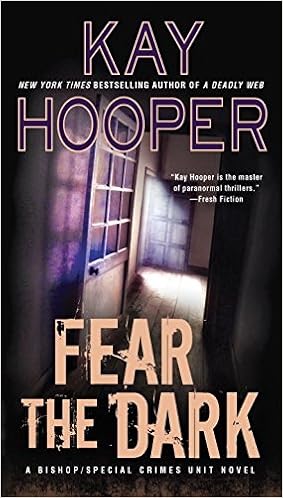
Fear the Dark by Kay Hooper


This is the sixteenth book in the Bishop/Special Crimes Unit of the FBI series.  If you are new to the series, do not fret.  She always writes her books in trilogies. This should be the first, if numerous past examples have shown, in such a trilogy.  Bishop is the head of a unit of FBI agents that he has specially formed, fighting an uphill battle with the bureau and other law enforcement officers along the way, completely with psychics. He recruits them and trains them as agents.  They learn what all agents learn: how to use a gun, profile, and old fashioned police work. Their psychic abilities are just another tool in the tool box, that sometimes can work against them.  Several books ago, thankfully, Hooper began including bios of the returning characters in the books and which books they were previously in (after a while, with so many, you tend to forget), definitions of terms, and a timeline of when the books take place.  Hooper, who lives in the mountains of North Carolina, sets most of her books in the southeast, mostly in Tennessee, North Carolina, and Georgia.

This book opens up in Serenity, Tennessee, a small mountain town, where two teens, who appear to have been running away together, have left their packed car and purse, with the doors wide open and the keys in the car, on the side of the road. Deputy Sarah Waters finds the jeep and their footprints that lead down the hill and suddenly stop. She calls Jonah, the chief, and they discover something even stranger: the amount of time they had spent there was the amount of time their watches had stopped for.  Jonah does not want to panic the town, so he has Sarah take pictures of the vehicle and the prints and has the jeep towed as quickly as possible.  They do not want anyone thinking something weird is going on, because that is when panic can creep in.

Soon, however, more people go missing, and when a ten-year-old girl, Nessa, vanishes from right inside her family's heavily secured home, with motion detection video cameras, Jonah, who has taken classes and worked on ops with the FBI, sends in a call straight to Bishop and asks them to come in.  Bishop's talent is a touch telepath, as well as having heightened senses (or spidey senses, as the team, refers to them as).  With his wife Miranda, whom he has a psychic bond, they share a precognitive ability, which means they can see many possible futures, which does them not much good because warning their team may bring about the fate they are trying to avoid.  He also, mysteriously, always knows what's going on with his agents in the field.  This is never explained in any of the books.  Bishop is a very mysterious character.

The four agents chosen to go to Serenity are: Lead agent, Lucas Jordan (He has the ability to find people who are lost by accident, victims of crimes, or abducted.  He can feel the pain and fear of the person and hone into where they are.  However, this does not work if they are drugged, dead, or do not want to be found), his wife, Samantha Jordan (Seer and clairvoyant.  She can not control precognition, but she is able, with great accuracy, to pick up information when she touches objects and people.), Robbie Hodge, a trainee (A born telepath, she's able to read about half the people she encounters and can coax memories from a willing person.  She also has a strong shield), and Dante Swann, trainee (A reluctant medium with very strong shields.  Though he has had his abilities for a number of years, he has yet to come to terms with them, however, he really enjoys the puzzles of investigative work.)

When they arrive, the FBI team go and investigate the sites and discover that the time problem is nothing supernatural, but rather energy bubbles that have spilled over from the kidnapper who used too much psychic power, because he lacked training, when he took his victims.  A psychic cannot leave their shields up at all times, or they will collapse at some point from exhaustion at holding them up.  When the FBI team and Jonah and Sarah are meeting that night around the table, Robbie has a small window open.  The kidnapper uses it to slip inside her mind and play around inside of it.  He tries to control her mind, but she is way too strong for that, so instead, he rearranges her memories. She realizes what is going on and yanks herself out, but overdoes it and her "mind" ends up on the street outside the police station.  Suddenly she sees a shadow stumble forward clutching their throat and fall over.  She knows that he is there and jumps back out again to find everyone in the room looking at her. When she explains what happened, her fellow agents are shocked, because her shields are so strong, no one can get in, so how did he?  When they go outside to see if what she saw really happened, they discover the body of a deputy, who had gone out, unarmed, to get dinner, and ran into the kidnapper who sliced her throat.  Quickly, Sam leans down and grabs her head, having Luke hold on to her in order to grab her, in case she goes to far, and she enters the deputy's dying mind to see her last thoughts.  Apparently, the deputy had seen or heard something that was bothering her about the case, but Sam was unable to grasp onto what it was before she died and took Sam with her.

The kidnapper is obsessed with Robbie, because her ability is similar to his and he wants to understand more about his ability.  He also thinks she can help him in some way.  The agents and deputies go over the victimologies, but its hard in a small town.  They are all bound to have many things in common, so its hard to figure out, just what it is that the kidnapper wants with them. The kidnapper, meanwhile, continues to find ways to attack the group and bring them down, which only seems to make them more determined to catch him and destroy him. Jonah is having a really hard time with this, because the people taken are his responsibility as chief and nothing seems able to work to stop this monster.  Then the monster sets a trap for them and things go horribly wrong after that.

I highly recommend this series.  Its gripping, on-the-edge-of-your-seats suspense that will have you flying quickly through the pages.  The characters are very real and you come to care about them.  They aren't superheroes.  They're people who are stuck with these abilities, for better or worse, and have decided to try to learn to use them to help others.  Its not your typical book with psychic characters. Their abilities are secondary.  They do, however, hunt down the true monsters out there, usually the ones who also have some kind of psychic ability themselves.  They solve their cases through good old fashioned police work.  Sometimes their abilities are able to help them with this, especially when they have to defend themselves against evil.  I could say that this book is rather unique among her other books, but really, they are all unique in their own way. She never repeats herself and each book in the series is fresh and never "the same old thing".  I really did enjoy this book, and as usual, want to start all over again so I can relive the old stories and remember everything from the beginning, including the backstories of the characters in this book, that I cannot quite remember, considering at least one of them was a very, very long time ago.  This is very much worth a read.

Postscript:  When I first started reading this book and Deputy Sarah Waters name came up, but wasn't in the back of the book, I began wracking my brain to figure out what book she was in, because the name was so familiar.  Then it hit me: It was the name Julia Robert's character took after she fakes her death and leaves her abusive husband in Sleeping With the Enemy.  Do not ask how on earth I know that.  I haven't seen that movie in over ten years.  Some things just come to me and I do not know why.  I do wonder if Kay Hooper knows that, though.

Quotes:
 She glanced at the old leather couch across the room from his desk. “That wasn’t sleep, that was time on a medieval torture devise. Unless you confessed you’re a heretic, it was useless time.”

--Kay Hooper (Fear the Dark p 31)


I’ve seen men in coffins look better than you.
-Kay Hooper (Fear the Dark p 32)
Link to Amazon:  https://www.amazon.com/Fear-Dark-Bishop-SCU-Novel/dp/0515156035/ref=sr_1_1?ie=UTF8&qid=1476452006&sr=8-1&keywords=Fear+the+dark
 

Wednesday, October 12, 2016

Dragon Fall by Katie MacAlister


Aoife (EE-fuh), who is half Irish, half Senegalese, but was born in America, goes to a GothFaire one night in Sweden and her life is turned upside down.  She meets a strange man named Terrin who claims that things like demons and dragons are real. He also gives her a ring to try on right before he ends up in a fight with a group of men, one of which chops his arm off leaving him dead and the instigators disappear in a puff of smoke.  Aoife calls the police, but by the time they get there not only is Terrin's body not lying there dead, he shows up very much alive and Aoife is taken away in an ambulance to a hospital for a psych evaluation.  When her brother, Rowan and her sister, Bee arrive they have her committed to the Arvidsjaur Center for the Bewildered for her own sake as she keeps insisting on what she saw. 

After two years in the looney bin where she had electric shock therapy as well as the regular therapy, Aoife is glad to finally be out.  Her sister is going to Africa on a work trip, so Aoife will be in the family home in Sweden alone. The GothFaire is in town and her doctor thinks it would be a good idea for her to go and see that there is nothing special about it, so she goes and walks around for a few minutes and leaves.  On the drive home, she hits a dog and puts it in her car to take it to the vet who tells her the dog should have died, but he's fine and now he's her responsibility since he has no identification. When she takes him out to the beach to go "walksies" he finds a man who has washed up on shore. He appears to be dead until she touches him and an electric shock runs from her body to his and he starts breathing again.  She calls the emergency number but they won't be able to get there for an hour so it's up to her to get him to somewhere for help. The hospital is too far away, but a doctor lives close by so they go there.

While the doctor is working on him he wakes up and believes that they are holding him prisoner and threatens them with his powerful brother.  Aoife tries to explain to him several times what is going on and eventually it sinks into a degree that at least they are not going to harm him, even if he's not sure he can trust them.  They go back to Aoife's house since he's rather beaten up and needs to rest.  The big surprise comes when he tells her he is a dragon and shows her his dragon form as proof and Aoife now knows that she wasn't crazy after all.  The two of them, of course, have an instant chemistry, but Kostya, the dragon, has not only been fooled once by a woman, he was held a prisoner and tortured for a long time and he does not seek a wyvern's mate ever.

The dog turns out to be Kostya's sister-in-law's dog, Jim, a demon in dog form who can talk, but has lost his memory and is now attached to Aoife instead.  When the house is attacked by red dragons, who are dragons that have demons in them, Aoife finally finds out the power of that ring that Terrin gave her and kills five dragons using it.  Kostya wants her to use the ring to break the curse the dragons are under that causes them to fight each sect when they see each other and are unable to understand what they are saying to each other.  Kostya is the leader of the black dragons and his brother, Drake, is the leader of the green dragons and whenever they see each other they fight. 

This is one wild adventure and Aoife has the most creative curses like "sweet scuppering salamanders". It is a fun chase watching as Aoife sets out to show Kostya that he can trust a woman again and whether he wants one or not he's getting a wyvern's mate.  Also, just what does that ring do and can it really solve the problems for the dragons?  For those not familiar with MacAlister, she has written four books about Aisling Grey, Drake's wife, and Jim's rightful demon lord, that if you want to read you can, but you don't have to.  They are, however, a great deal of fun and will provide background for what is happening.  This is the first book in what is going to be either a trilogy or a four book series and I can't wait to find out what happens next.

 Quotes:


Holy mayonnaise and all the little condiments…
-Katie MacAlister (Dragon Fall p 46)


If there’s one thing I learned at Casa de Crazy, it’s that lying to yourself never ends well.
-Katie MacAlister (Dragon Fall p 180)
 Someday, I’m going to be able to have a conversation with you and actually understand every word you say.

-Katie MacAlister (Dragon Fall p 182)
 To retreat when you cannot win a battle is not cowardly. It is self-preservation.

-Katie MacAlister (Dragon Fall p 185)
 Ah, my friend, it is the way of women to keep us humble, is it not?

-Katie MacAlister (Dragon Fall p 189)
 I sighed, fully engulfed in martyr mode. “It doesn’t matter now. I’m doomed, doomed, doomed.” “Emo much?” “Doomed with a smart-aleck demon.  This just gets better.” “Man, you are a Debbie Downer today.”  “I am not! And if I was, I have every right to be one. I mean look at the situation!” “I am. It’s not that bad.” “Are you insane? How can being locked in a cell in hell not be bad?”

-Katie MacAlister (Dragon Fall p 225)
 Nope. Sorry. I’ve reached maximum capacity of things I don’t know, and I just can’t handle one more thing.

-Katie MacAlister (Dragon Fall p 289)
Link to Amazon:  https://www.amazon.com/Dragon-Fall-Katie-MacAlister/dp/1455559210/ref=sr_1_1?s=books&ie=UTF8&qid=1476279764&sr=1-1&keywords=dragon+fall


Monday, October 10, 2016

Dracula by Bram Stoker


This classic, just in time for the upcoming Halloween, is a book, I'm ashamed to say, I have never read.  I've always meant to, but now, I can happily say that I have.  It starts out with Jonathan Harker, a junior lawyer in a firm goes to Transylvania to give information about real estate and other matters the Count has hired his firm to set up for him.  Soon, he finds that nothing is as it seems and that his host has locked him inside the castle with three vampire women who want a taste of him.  Jonathan manages to escape but isn't sure that the things he wrote in his journal are true or his imagination.  He gives the journal to his new wife Mina to read if it becomes necessary.

While Jonathan is away, Mina's friend, Lucy, stays with her and suddenly starts to sleepwalk again, even going so far as to leave the house.  Lucy soon becomes ill and the three men who asked for her hand in marriage an American, Quincy, Dr. John Steward, who runs an insane asylum, and her fiancĂ©e Lord Arthur, all give her blood transfusions, which is rather funny, in today's realm when blood type is necessary, not the physical fitness of the giver.  Dr. Steward calls upon his old teacher Dr. Van Helsing for help and try as they might, they are unable to rescue Lucy.

When Dr. Helsing writes to Mina to tell her about Lucy's death, the two soon meet and compare notes with Jonathan's journal and discover that the Count is in London and must be stopped at any and all costs.  An interesting side note: there is no mention of sunlight being able to harm the vampire.  Time is not on their side, as the Count has taken a part of Mina and she is turning into a vampire herself.  The five men must race against the clock to get to the count before Mina turns into a vampire or he finds a shelter they are unable to penetrate.

This was a hard book for me to read, in that I have a hard time reading books written in journal/letter form.  I had trouble reading The Diary of Ann Frank and that is considered one of the top one hundred books to read.  I also had trouble reading Interview With a Vampire by Anne Rice, which is quickly becoming a classic on its own.  That being said, I'm glad I read it.  In the end, it did hook me, even if it took me longer than it should have to read.  It truly is a classic worth reading that leaves you satisfied at the end.

Quotes:
 Despair has its own calms.

--Bram Stoker (Dracula p 47)
 How well the man reasoned; lunatics always do within their own scope.

-- Bram Stoker (Dracula p 77)
 For life be, after all, only a waitin’ for somethin’ else than what we’re doin’; and death be all that we can rightly depend on.

-- Bram Stoker (Dracula p 80)
 All men are mad in some way or the other.

-- Bram Stoker (Dracula p 128)

 Link to Amazon: https://www.amazon.com/DRACULA-Wisehouse-Classics-Original-1897/dp/9176372162/ref=sr_1_4?s=books&ie=UTF8&qid=1476104339&sr=1-4&keywords=dracula

Wednesday, October 5, 2016

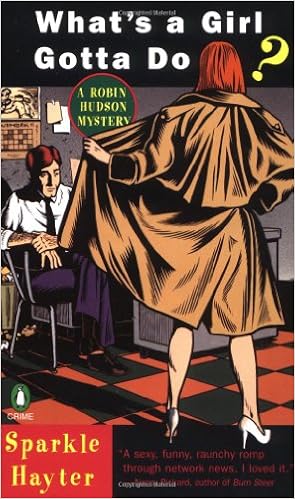
What's a Girl To Do by Sparkle Hayter


Robin Hudson's life has been in a downward spiral lately.  Her upwardly mobile career at the CNNish network ANN, that was started by Georgia Jack Johnson (Think Ted Turner) in New York City, went into a tailspin when called upon to ask her first question at a While House briefing she belches and then another faux pas on a story where she alluded to cannibalism got her a one way ticket to Special Reports where they do tabloid-like stories and her boss is the sleazy Jerry Spurdle.  On top of that, her husband Burke has left her for a younger woman, Amy Penny, that she works with and has to see every day.  Burke is a reporter for a local station.

Robin is used to mysterious phone calls as she has odd fans, but this one alludes to knowing things from her past and wants to meet her at the ANN New Year's Eve Ball if she wants to know what else he has on her.  So Robin loads up her pocket book with the usual weapons of her perfume bottle filled with cayenne pepper and her Epilady (she has booby trapped her apartment including using poison ivy at the windows to help identify or at least irritate thieves).  At the party, a man comes up to her and hands her an envelope that has a page with blacked out sections on it and a note to meet him at 11pm in one of the hotel's rooms.  While she's at the party she aggravates her ex and flirts with the handsome Eric who works in production for one of the shows.  When she goes up to the room no one answers the door and it is silent so she leaves.  The next day she is brought down to the police department for questioning in the man's murder.  However, the guy was a P.I. who made a lot of enemies and was blackmailing some people who weren't Robin, means she is quickly cleared as a suspect, but that only peaks her interest in solving the murder.

But Jerry has her busy doing actual work for Special Reports. Mainly a show on sperm being switched at a shoddy sperm bank and couples ending up with mixed race babies that clearly are not wholly their own.  Jerry, of course, wants to go undercover with Robin as a couple to the sperm bank and finagle a tour of the place and get on hidden camera all the goods. Claire the other part of the team who does the research and production is close friends with Robin, even though Claire is likely moving on to a better job soon.

And of course there's also Eric who is not only flirting back with Robin but trying to go out with her, but it's been such a long time since she's been on the dating scene she doesn't know what she's doing and she's scared of him being a playboy or of trusting him.  After all, someone in the office is being blackmailed by the P.I. and likely killed him and won't hesitate to kill again, especially if Robin, wise-cracking amateur gumshoe, gets too close to the truth.

Quotes:
 Two calls from Elroy, one of my “special fans,” who sees me as his dominatrix and gets off by calling or writing me to describe the many ways he wants me to punish him.  This time he wanted me to spank his bare bottom with a razor strap and then glue his eyelids shut with Krazy Glue. And they say romance is dead.

-Sparkle Hayter (What’s a Girl To Do p 41)


The thing is, I still sort of believed in love. I was kind of agnostic about love, actually, but I hadn’t lost all hope completely. I was waiting for the feminist wet dream, Spencer Tracy. And while I was waiting, great looks and a great bod could tide me over nicely.
-Sparkle Hayter (What’s a Girl To Do p 70)
 If you want to debunk one conspiracy theory, give ‘em another.

-Sparkle Hayter (What’s a Girl To Do p 115)


In fact, I am a slob. I admit it. It’s not that I’m a lazy person. I tend to workaholism and when I do clean, I clean compulsively, unable to stop until the place is completely spotless. But housework just seems so insignificant and, as men have always known, there’s always something better to do.  I haven’t read Moby Dick yet. I haven’t seen Fellini’s Satyricon.  There are dozens of countries in the world about which I know nothing and billions of people I haven’t yet met.
-Sparkle Hayter (What’s a Girl To Do p 139)
 There is Murphy’s Law and there are Robin’s Amendments. Number one. The guy with the biggest tub of popcorn and nosiest eating habits will always sit directly behind me in a movie theater (or else a hearing-impaired foreign national with his translator, so that every line of on-screen dialogue is repeated in loud German). Number two. The amount a man adores me is roughly equal to the number of his faults.  Number three. When I’m already running late, something will inevitably happen to make me even later.

-Sparkle Hayter (What’s a Girl To Do p 145-6)


A girlfriend and I discussed this once, how a touch of pathos, a hint of haggard, makes a man more attractive to a woman.  When courting hesitant females, the males of other species cinch the biological deal by puffing up their brightly colored plumage. All our men have to do is not shave for a day and stint themselves on sleep.
-Sparkle Hayter (What’s a Girl To Do p 148)
 Yeah, too bad there aren’t really witches. Too many televangelists in the world, not enough frogs. One twitch of Samantha’s nose could fix that little imbalance.

-Sparkle Hayter (What’s a Girl To Do p 173)


Burke, after surveying my umbrella, my poison ivy, and my spray colon spiked with cayenne pepper, once asked me if there was anything that couldn’t be a weapon if it fell into my hands. The only thing I could think of was Jell-O. “To you the world is just full of weapons, isn’t it?” he said. Yep, and the world is just full of reasons to use them, I thought now, as I left the store, prepared in my heart to bludgeon a man to death with a coffee can if necessary.
-Sparkle Hayter (What’s a Girl To Do p 200)
Link to Amazon: