I do not think that there can ever be enough books about anything and I say that knowing that some of them are going to be about Pilates.The more knowledge the better seems like a solid rule of thumb, even though I have watched enough science fiction films to accept that humanity’s unchecked pursuit of learning will end with robots taking over the world.-Sarah Vowell

Wednesday, August 31, 2016

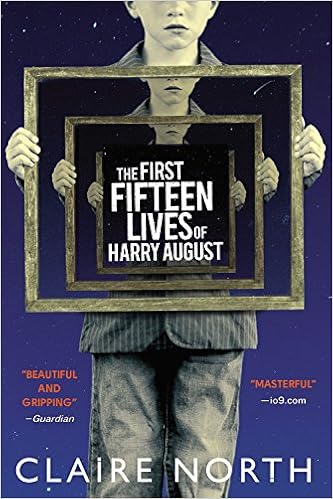
The First Fifteen LIves of Harry August by Claire North

This is the story of Harry August, whose father was the "lord of the manor" on an estate in northern England, and upon hearing of his wife's unfaithfulness, rapes the maid. When she becomes pregnant, she is kicked out without references.  She scrapes together the last of her money to pay for a train ticket to Edinburgh, where her family is located.  On the way, she goes into labor in a bathroom and a kind couple delivers him on January 1, 1919.  She bleeds to death before the medic can get there.  She had told this couple about the Augusts who might take him in.  With the help of Harry's biological spinster aunt, who pays the Augusts, their groundskeeper,  to raise the child.  Harry's adoptive mother dies when his is seven and his father retreats inside himself.  Harry then goes on to enlist during World War II, where he saw little action and would go on to lead an unremarkable life, until his death in the 1970s when he dies of multiple melanomas.

Then Harry is born again, in the same manner, but when he reaches the age of four, he has full knowledge of the life he led before.  This drives him, as it does others of his kind, crazy and he is put in a mental institute and jumps to his death off the top of the building at the age of seven. In his third life, he seeks answers in religion and travels the earth searching for the answers to his existence.  Again, he dies of melanoma and is reborn.  This time, he studies medicine and meets the first female surgeon in Britain, whom he marries.  When he slips up and tells her his story, she laughs it off, until the things he says will happen soon, actually  do, she has him committed to a mental institution.   While life in these institutions was horrible at this time, at least he wasn't being put  on any drugs, until one day his psychiatrist has him held down and injects him with what could be LSD, ecstasy, anti-psychotics and various poisons of the day.  When his wife visits he tries to communicate what he is going through, knowing that as a doctor, she could help him, but he is unable to move or talk.

Eventually, a man named MacPherson, a British spy, gets him out of that hellhole, but he has an agenda of his own.  He has heard of a group of people that are mentioned in the small footnotes of history called the Cronus Club, which has been around for centuries and seems to be born over and over again, and therefore has knowledge of the future.  He offers Harry information on the Chronis Club if he will tell  him about future events.  At first, this works out fine. Harry does not give out too many specifics.  But soon, his relationship with MacPherson changes and he wants in-depth details and Harry realizes that he could seriously change the timeline and cause damage.  He escapes, knowing that he will eventually be caught, with the express purpose of mailing two letters: one to his wife via a friend, apologizing for everything and the other to a trusted friend and colleague asking him to please post an ad in three newspapers .  He is then caught and the gloves come off. He is physically beaten, given drugs, and psychologically tortured for three days, before Virginia, a member of the Chronis Club arrives to tell him to meet her at Trafalgar Square on July 1, 1940, and she would explain all.  She tells him he will suffer from post-traumatic stress disorder in his next life and suggests that since the psychologists of the time were Freudian, he always has the option of the confessional, even if it does freak out the priests.  She gives him a pen knife and suggests the thigh, as the femoral artery hurts less and bleeds out the quickest.     

In his fifth life, he studies physics and meets up with Virginia who gives him an overall view of the club.  There are many in various cities around the world and they are always moving.  The future and past generations communicate with each other by leaving messages on stones and such or by passing it down from person to person.  While he is allowed to play with the timeline a little bit (saving a friend's life, making money off the stock market) they are not allowed to do anything drastic, such as killing Hitler.  They are also expected to donate money to the children's fund to set up new ones in life.  Also, he is never to reveal where and when he was born, or what his true name is.  She explains the two deaths available to the people of their kind: the Forgetting, where their brains are given electrical shocks, wiping the memory clean and then they are killed.  When they are born again, they will have no memory of their previous lives.  The other way is to be killed in the womb and never be born.  That has been done only once before when a man from the thirty-years-war in the 17th Century is tired of all of the death and destruction and wants to do something.  He goes to the most powerful kingdom of the time, France, and tells the king of the future.  Soon, France has taken over Europe and most of Africa.  Technology is accelerated and by 1953 two nuclear bombs are set off from Australia, causing a nuclear winter, killing everything on the planet.   Those that are reborn, send messages back through time about what happened and that this man needs to be stopped and he is killed before being born.

Now, at the end of Harry's eleventh life, a young girl appears at his hospital bed and tells him the news from the future that the earth is ending much sooner than normal.  Harry knows who is behind this, a young student he met as a professor at Oxford.  When he finds him, he gives into the temptation to help him build a Quantum Mirror, which would, to quote Douglas Adams give the answers to "life, the universe, and everything."  Finally, he would know who or what he is and his purpose in life.  Instead of stopping him, he helps him, but the longer he does this, the more he realizes that it is wrong and he must stop him.

Soon the two are locking horns across lifetimes and Harry must resort to sneaky tactics to try to keep this student from his goal, which is already wrecking havoc in the world with the invention of machines years before their time, and the inevitable next step the scientists will take.  Members of the Chronis Club are siding with the student, and Harry must be careful of who he can trust.  More importantly, he must discover the student's origins and end him before he ends the world.      

I read this book in one sitting.  I could not put it down.  In a way, these two men have all the time in the world; the truth is this is a game and the stakes are high.  If Harry cannot stop him soon, the world will be lost and everyone in it.  Harry is the only one strong enough and smart enough to win this game, but his student will not go down easy and will try to take Harry down with him.          

Link to Amazon:  https://www.amazon.com/First-Fifteen-Lives-Harry-August/dp/0316399620/ref=sr_1_1?s=books&ie=UTF8&qid=1472647314&sr=1-1&keywords=the+first+fifteen+lives+of+harry+august                                  

Friday, August 26, 2016

Liar Temptress Soldier Spy: Four Women Undercover in the Civil War by Karen Abbott


In this incredibly fascinating look at four women, two from the North and two from the South, Abbott examines their incredible feats and exploits during one of the most devastating wars in America.  She follows Belle Boyd, a seventeen-year-old Southern rebel, Mrs. Rose Greenhow, a conniving spy for the Confederacy, Emma "Frank Thompson", who served in the medical corp and as a spy for the North, and Elizabeth Van Lew, a Unionist from Richmond, who helped men escape from prison and helped a great spy network all under the watchful eyes of top Southern military men and even President Jefferson Davis.

Belle Boyd's first entry into the war was when in her divided town of Martinburg, Virginia, in the Shenandoah Valley, killed a Union soldier who was molesting her mother.  Soon she was riding her horse Fleeter to deliver messages to different regiments and give them intel she gleaned with her grace and charm from Union soldiers during the various times her town was taken over by them (on one day the town changed hands thirteen times).  Belle wanted to be famous and "feared the enemy might forget her very existence unless she took measures to remind them."  She was instrumental in the Shenandoah Campaign and flew across a battlefield, her hat flying, to get news to Stonewall Jackson that the Union troops were few and that he should push ahead. Eventually her deeds would have her end up in prison in Washington D.C., where every whim she had was catered to.  She would be released on the condition that she not come north again, which she disregarded when her family became ill and her hometown was now West Virginia, a Northern state. 

Mrs. Rose Greenhow of Washington D.C. had two older daughters she sent to California for the duration of the war, but kept her eight-year-old daughter Little Rose with her.  Rose could romance a great deal of information from Senators and high ranking officers and was considered the reason the South won the Battle at Manassas (otherwise know as Bull Run).  She had a complicated network of female spies all around town.  Before the first year of the war was up she was captured by Pinkerton, the self proclaimed head of the "secret service" and a spy catcher.  They arrest Rose and her daughter (whom she also uses to pass along information) and put them in jail.  After a few months, she and her daughter are granted their freedom if she promises to not go back into the North.  This will be not the only thing she does for the Confederacy, though.

Emma, a nineteen-year-old woman from Canada, had been impersonating a man in order to get out of a planned wedding to a lecherous old man.  When the war started she immediately joined up, believing it God's will.  She mainly stays in the medical corps helping to bring soldiers off of the battlefield.  She also went undercover as a slave twice and once as an old woman to glean information about the South's military.  She was constantly in fear of being discovered as a woman, and she wasn't the only woman to fight as a man, there were many, but she still chose two different men to confide her secret to and they kept it.

Elizabeth Van Lew, her mother, and her brother, John, let their slaves buy their freedom and she even let her own slave, Mary Jane, receive an education at a Quaker school in Pennsylvania, before the war.  At first Elizabeth doesn't know how she can help.  She starts by visiting the soldiers in the hospital, bringing food and other items.  Soon, though she concocts a plan that involves one of the Confederate officers of the prison, who would pick a soldier out and then have him secretly put on a Confederate uniform and send them to her house, where they would hide out until they could be secreted out and given directions and messages about the military in Richmond on their way to the Northern side.  She even gets her maid, Mary Jane, who had an eidetic memory, employed at the Confederate White House to memorize Davis's papers and send the messages in Mrs. Davis's dresses that were to be mended.  The North would go through many Generals before Hooker (yes, the General whose army had so many prostitutes that that is where the name comes from) realized there was an excellent and effective spy ring right there in Richmond and began using it.  She was constantly under suspicion and had her house searched.  Most of her neighbors hated her for her views and what they suspected she might be doing.

These four women risked everything for their countries during a devastating war, where you never knew who to trust or who might be a spy trying to entrap you into giving yourself away.  They are heroes, just as the men who fought the war were.  They weren't the only women fighting this war, though.  Some women hid supplies and weapons inside their voluminous skirts ("One woman managed to conceal inside her hoop skirt a roll of army cloth, several pairs of cavalry boots, a roll of crimson flannel, packages of gilt braid and sewing silk, cans of preserved meat, and a bag of coffee...") across distances to get them to the soldiers.  Sadly, though, their life after the war wasn't as happy.  I highly recommend this book that looks into the lives of these four incredible women.

 Link to Amazon: https://www.amazon.com/Liar-Temptress-Soldier-Spy-Undercover/dp/0062092901/ref=sr_1_1?s=books&ie=UTF8&qid=1472215091&sr=1-1&keywords=liar+temptress+soldier+spy+four+women+undercover+in+the+civil+war

Monday, August 22, 2016

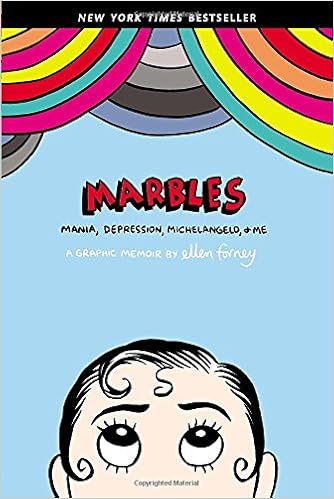
Marbles, Mania, Depression, Michelangelo and Me: A Graphic Novel by Ellen Forney


In 1998, not too long before turning thirty, Ellen Forney, an artist, finds out that she is manic depressive and is in fact having a manic episode. Her psychiatrist wants to put her on medication but she worries that the meds will effect her art and creative mind, so she refuses at first.  She does research into other artists who have been mentally ill and if she's a manic depressive, it's pretty cool to be included in the "crazy artist" club, which includes such people as Gaugan, van Gogh, Gorky, Michelangelo, Munch, O'Keeffe, Pollack, Rossetti, Rothko, Baudelaire, Blake, Burns, Byron, Dickinson, Eliot, Hugo, Keats, Millay, Plath, Poe, Sexton, Tennyson, Whitman, Hans Christian Anderson, Twain, Conrad, Dickens, Faulkner, Fitzgerald, Hemingway, Ibsen, James (both), Mary Shelley, Tolstoy, Williams, Woolf, and Zola.

While she studied these people she found that a lot of them spent time in asylums, made suicide attempts, or succeeded in killing themselves.  Some stats she picked up: the suicide rate in the overall population is 11.2 in 100,000 and attempts is 8-25 per every suicide death, while in the manic depressive population it is an estimated 25%-50% for attempts and 3%-20% for successful suicide death rate.  [Most people cite 15%, but that can vary depending on many factors (On the low end for non-hospitalized groups, on the high end when illness is combined with alcohol abuse, low end for medicine takers, high end shortly after onset of illness, etc...)]   As manic as she is at the moment she views her disease as a superpower or a gift to her creativity and its a good thing that the depression isn't a problem of hers. 

While she's on a manic high, she doesn't feel as though she needs any meds; that she will be fine. She forgets completely the crash that always follows the mania or how out of control the mania can get.  For her thirtieth birthday she decides to throw a huge party to coincide with the release of her first book, a collection of her weekly comic strips, "I Was Seven in '75".  She held it in a club with a local band, had party hats, a friend to emcee the event, a host of different acts to perform on stage, as well as a spin art booth, games, and prizes. 

Afterwards she tells her father and brother, as her mother, a doctor, is the only one knew up until then, except for a few friends.  It turns out mental illness runs in her family and her mother is a bit Cyclothymiaic [Alternating Hypomania and Mild Depression].  The official terms are Bipolar I: Alternating Manic and Depressive Episodes (Ellen); Bipolar II: Alternating Hypomanic and Depressive Episodes; Unipolar Depression: Single of Recurrent Episodes with No Mania; Dysthymia: Chronic, Low-Grade Depression.  The mood chart goes: Mania (Up! Up! Up!); Hypomania (Up!); Mixed States (Up and Down at the Same Time); Rapid Cycling (4 Or More Episodes Within 12 Months); Euthymia (balanced, "Normal"); Dysthymia (Chronically Low); Mild Depression (Low); Depression (low, low, low, low). 

Mania includes the symptoms: inflated self esteem or grandiosity, decreased need for sleep, more talkative or pressure to keep talking, flight of ideas or racing thoughts, distractability, increase in goal oriented activity, excessive involvement in pleasurable activities that have a high potential for painful consequences (gambling, hypersexuality, buying sprees, etc...). Depressive symptoms include: depressed mood every day most of the day, markedly diminished pleasure in all or almost all activities, weight loss or gain, insomnia or hypersomnia, fatigue and loss of energy, feelings of worthlessness and inappropriate guilt, diminished ability to think or concentrate, and recurrent thoughts of death or suicide.

Sure enough she crashed into a major depressive episode not long after the birthday party.  That is when she asked her psychiatrist for the lithium. The lithium, however, works best on mania, not depression.  It also has lots of fun side effects like: weight gain, hand tremor, mental slowness, poor concentration, memory problems, acne, "cognitive dulling", liver toxicity (which means you have to drink 3 liters of water a day. In this book, she tries other medicines such as Klonopion (for sleep and relaxation), Depakote (which, like lithium requires blood draws to check on certain things), Celexa, Neurontin, Zyprexa, Tegretol, and Lamictal. Today there are lots more to choose from with lots of side effects. They can all cause weight gain, possible drowsiness, memory loss [manic depression itself causes memory loss], stomach issues, sexual side effects, and many, many more.  You can end up taking more than one medicine.  Perhaps one for depression and one or two to stabilize your moods or mania.  You may also need a sleep medication or something for anxiety, which is also common in those with manic depression. 

While depressed she still made it out of bed and to the couch and maybe that was good enough for that day.  Her mother and psychiatrist were very supportive of her and the friends she told became so too.  She loved to swim and eventually that would be what she would do three times a week like she used to do.  She would learn to find a way to do her cartoon strip no matter how much effort it took her or how long it took her, as this was how she made her living and the rent had to be paid.  There would be an incredible chance to interview a favorite author of hers and she will have to figure out if she can manage that or not.  Before when she was manic she has signed up to do the Danskin Triathlon and she still wants to do it even though she stopped training for it when the depression hit. Will she be able to get out of bed to do it and if so will she be able to finish the race?  There's also a great deal of embarrassment and shame that comes from being manic depressive.  You don't want people to treat you differently or think that you are crazy. 

This book perfectly illustrates what being a manic depressive is like. Forney expertly draws what goes on in the mind of a manic and what it really feels like to be depressed.  You get a real sense of this in her book. She also provides a great deal of useful information for those who fall in the spectrum of manic depression/depressive illness to use to see what is going on in their lives and how to get help. Most important she shows that this is a livable disease and that you can soldier on and make a life for yourself, even if it takes a while to find the right medicine combination.  She also shows that you don't have to be ashamed of being manic depressive. 

Link to Amazon:  https://www.amazon.com/Marbles-Depression-Michelangelo-Graphic-Memoir/dp/1592407323/ref=sr_1_1?s=books&ie=UTF8&qid=1472050475&sr=1-1&keywords=marbles+mania+depression+michelangelo+%26+me+a+graphic+memoir


Billy's Long Halftime Walk by Ben Fountain


In this NY Times best seller and National Book Award finalist, SPC William "Billy" Lynn is on a two week tour of America with seven other guys who have been deemed heroes of the Al-Ansakar Canal battle in Iraq in Oct of what I will say 2005*. The end of the tour will be a Thanksgiving Day spent at Texas stadium where Destiny's Child is doing the halftime show.  Most of the book takes place there with Billy trying to figure some things out in his head, with a small bit taking place two days before at his parent's place.

"One nation, two weeks, eight American heroes, though technically there is no such thing as Bravo squad. They are Bravo Company, second platoon, first squad, said squad being comprised of teams alpha and bravo, but the Fox embed christened them Bravo squad and thus they were presented to the world."  Who are they? "Herbert known as A-bort...then Holliday known as Day, then Lodis a.k.a Cum Load, Pant Load, or just plain Load, then Sykes who will never be anything other than Sucks, then Koch as in coke which makes him Crack and Crack kills!, especially when he squats and shows a slice of his ass, then Sergeant Dime", there's also the one who barely made it, SPC Lake who is in the hospital with his legs blown off and Sergent "Shroom" Breem, who didn't make it, for whom Billy is having the hardest time dealing with his death, probably because he was a mentor and he was holding him when he died and as he says felt his soul pass on to somewhere.  At Shroom's funeral is the only time they seem to encounter people who seem to hate them. Those evil people with their signs that hold biblical verses and words like "baby killer".   Everyone else seems happy to know that something right is going on over there and that we're killing actual terrorists.

The soldiers have taken on a movie producer Albert Ratner who has practically promised them he will get them $100,000 up front each and a percentage of the backend profits.  So far after two weeks he has not gotten them a deal but now Hilary Swank has shown a real interest only she wants to play Billy's part in the movie. However, Swank won't do the movie without a studio backing it and Albert is having a hard time getting a studio to back it. He's beginning to look at independent investors such as the owner of the Cowboys, Norm Oglesby who is very interested in expanding into making movies.

Part of their day involves meeting the famous Dallas Cowboy cheerleaders and Billy instantly falls for the strawberry blonde Faison with whom he makes out with and she seems taken with him as well.  It becomes a comedy of errors for him to try to get not just her phone number or email address but her last name, as he makes attempts to see her during the game and at halftime.  This is the closest the poor barely virginal Billy has come something real with a woman that he has been looking for over the past two weeks.  He wants something more than just sex with a woman and Faison seems to provide it.

They barely make it through the half-time show as it is a real extravaganza with fireworks and loud noises going off everywhere and they have no real idea where they are supposed to be at any given moment until they are told to march.  Load is drunk off his ass and Sykes is balling his eyes out, but they march on the best they can through the frozen sleet that is falling on the ground and the wretched spectacle that they are forced to be a part of.  It's like some kind of PTSD hell.  Afterward,  the reality of the movie deal begins to become apparent as the clock ticks down to their departure back to Iraq where they will finish their tour of duty, that in a way at this point they are looking forward to.

Throughout the book, Billy is contemplating the meaning of life in a very unique and creative way that only a cynical nineteen-year-old who has seen more than most of us having can.  He was given the choice of going to jail or the Army after he tore apart his sister's ex-fiance's car after the guy broke up with her when she was in a horrendous car accident that left her heavily scarred and needing multiple surgeries that she is still going through.  His sister blames herself for Billy being in danger and does something dangerous herself to try to save her brother.  So Billy has, even more, to think about as the day passes by.  This is not your typical war book and the author has a creative way of writing certain things such as when people crowd up to the Bravos and start saying things the words on the page are haphazard as though they are coming at Billy from every direction and are of course written in the Texas twang dialect.  I also love the way the "Star Spangled Banner" is sung on the page. It is one of the hardest songs to sing and he depicts it so accurately here. This book does seem to be down on Bush, but it was written in 2012 when we knew so much more about his presidency and the WMDs or lack thereof.  But it is not a political book. It is a soldiers book. A soldier who is taking a moment to reflect on life and death as he knows it before going "once more into the breach."

*The author took creative licence with the time line in that the novel the new stadium was announced in April of 2004, which does not fit with the other facts in the book and Destiny's Child sings at halftime and they broke up at the beginning of 2006. In the book they are still in Irving, Texas, but in the book, as you may have noticed, the owner's name is different. The roster is also made up. Yes, I am anal enough to try to pinpoint a year for when this imaginary event took place.

Quotes:


So they’ve lost Shroom and Lake, only two a number man might say, but given that each Bravo has missed death by a margin of inches, the casualty rate could just as easily be 100 percent. The freaking randomness is what wears on you, the difference between life, death, and horrible injury sometimes as slight as stooping to tie your bootlace on the way to chow, choosing the third shitter in line instead of the fourth, turning your head to the left instead of the right. Random. How that shit does twist your mind.
-Ben Fountain ( p 26-7)
 If a bullet’s going to get you, it’s already been fired.

-Ben Fountain ( p 27)
 You can deny him, he thought, watching his father across the table. You can hate him, love him, pity him, never speak to or look him in the eye again, never deign even to be in his crabbed  and bitter presence, but you’re still stuck wit the son of a bitch. One way or another he’ll always be your daddy, not even all powerful death was going to change that.

-Ben Fountain ( p 79)
 There was no such thing as perfection in this world, only moments of such extreme transparency that you forgot yourself, a holy mercy if there ever was one.

-Ben Fountain ( p 103)
 Billy tries to imagine the vast systems that support these athletes. They are among the best-cared-for creatures in the history of the planet, beneficiaries of the best nutrition, the latest technologies, the finest medical care, they live at the very pinnacle of American innovation and abundance, which inspires an extraordinary thought—sent them to fight the war! Send them just as they are this moment, well rested, suited up, psyched for brutal combat, send the entire NFL! Attack with all our bears and raiders, our ferocious redskins, our jets, eagles, falcons, chiefs, patriots, cowboys—how could a bunch of skinny hajjis in man-skirts and sandals stand a chance against these all-Americans? Resistance is futile, oh Arab foes. Surrender now and save yourself a world of hurt, for your mighty football players cannot be stopped, they are so huge, so strong, so fearsomely ripped that mere bombs and bullets bounce off their bones of steel. Submit, lest our awesome NFL show you straight to the flaming gates of hell!

-Ben Fountain ( p 184)
 “When he died, it’s like I wanted to die too.” But this wasn’t quite right. “In a way it was like the whole world died.” But that wasn’t it either. “In a way it was like the whole world died.” Even harder was describing his sense that Shroom’s death might have ruined him for anything else, because when he died? When I felt his soul pass through me? I loved him so much right then, I don’t think I can ever have that kind of love for anybody again. So what was the point of getting married, having kids, raising a family if you knew you couldn’t give them your very best love?

-Ben Fountain ( p 218)
Link to Amazon: https://www.amazon.com/Billy-Lynns-Long-Halftime-Walk/dp/0060885610/ref=sr_1_1?s=books&ie=UTF8&qid=1471876745&sr=1-1&keywords=billy+lynn%27s+long+halftime+walk+ben+fountain


Friday, August 19, 2016

Wings of Fire by Charles Todd


In this second of the Inspector Ian Rutledge of Scotland Yard, set after World War I, Rutledge is once again sent on a fool's errand to keep him away from a more sensational murders occurring in London by a man the papers are calling the new Jack the Ripper.  This time, a woman from a prominent family has called the Yard because she suspects something is not right after the apparent double suicide of her cousins Nicholas and Olivia and the "accident" of her other relative Stephen, falling down the stairs after their deaths.  In reality, this Lady, Rachael, is in love with Nicholas and can't believe he committed suicide and if he did, then why.  She isn't at all prepared for the trouble the Inspector causes by stirring up old memories and deaths in the family.

First off there is Rosamunde, a Trevylne by birth who married a man named George and had twin
daughters Olivia and Anne.  When George died in India, she remarried a man named Mr. Cheney and had two sons by him, Richard and Nicholas and their cousin Rachel.  When he died of an "accidental" gunshot wound, she married a man named Fitzhugh, who was in charge of her racing horses and had a son named Cormac.  With him, she had twins, Suzanna and Stephen.  The first to die was Anne.  She "fell" out of a tree when she was a young girl.  Then Richard, who went missing when he was a very young boy.  Then Cheney and eventually Fitzhugh, who supposedly fell off his horse on the beach, with a blow to the head.  Lastly was Rosamunde, who "accidentally" took an overdose of laudanum for sleep, just when she was getting her life back and was seeing a new man.

It soon becomes apparent that someone in the family is an evil murderer and Olivia is either that person or is protecting the one who is, perhaps Nicholas.  The house was left to Olivia in her grandfather's will because he didn't want the Fitzhughs getting it, as they were slightly lower class than his family.  Olivia, a cripple never left home and Nicholas remained by her side for the rest of their lives until that fateful night when they either committed suicide or one was murdered and the other committed suicide, or perhaps, even stranger, someone killed them both.

Rutledge, with the voice of the soldier he had killed for desertion during the war, still yelling in his ear that the only reason he doesn't want the murderer to be Olivia is because of her haunting and moving poetry that got many soldiers through the war and was thought to be written by a man, as only a man could know the horrors of which she wrote.  And if it was Olivia or Nicholas, does it truly matter if they're dead?  That's what Rachel wants to know.  She refuses to let him betray Nicholas if he is the killer and he refuses to let it go if it is Olivia.  But there's also the death of Stephen, who inherited Olivia's papers.  Did he find something in them that caused someone to somehow cause him to fall down the stairs?   Or was his death really just an unfortunate accident?

The more you read, the more uncertain you become of who the killer is and what really happened.  It's like a tennis match going back and forth until you're dizzy trying to figure out what really happened.  Rutledge turns to Olivia's poetry and finds some answers, and also a collection of "trophies" from the murdered victims hidden in her room.  Did she put them there, or someone else?  With no proof, he must depend on the small amounts of accounts from the townspeople of the time, especially Sadie, a senile old woman, who has lived through it all and knows more than she is telling, to form the whole picture and find the killer.

Link to Amazon: https://www.amazon.com/Wings-Fire-Inspector-Rutledge-Mysteries/dp/0312965680/ref=sr_1_1?s=books&ie=UTF8&qid=1471612371&sr=1-1&keywords=wings+of+fire+by+ian+rutledge

Wednesday, August 17, 2016

The Hot Zone by Jayne Ann Kretnz writing as Jayne Castle


This book is one of Jayne Ann Krentz's science fiction Harmony books,  when a group of humans left earth and landed on the planet Harmony and set up a base there.  But the curtain between the planet and earth would close and these colonist would be stuck with each other, for better or worse.  Aliens had once lived on this planet long ago and left it.  They are believed to have lived underground in the catacombs that are made of some kind of green mineral.  Over the years, the humans began to develop psi abilities which allowed them to use amber to "rez up" things such as cars, microwaves, cell phones, locks, etc... Some would develop particularly strong psi talents that required the use of amber to do, such as tuning amber (it has a unique frequency and if you go into the catacombs without tuned amber you will wander around until you go mad and die), read auras, handle and create "ghosts", or UDEMs (electrical energy that manifests in the form of a ghost) in the catacombs, music talents, botany talents, the ability to find and handle minerals, the ability to use alien technology.  The list is pretty endless. There are also dust bunnies, mysterious creatures with an endless apatite, who come and go as they please, collect the oddest things, and form attachments with humans. They have the loyalty of a dog who always knows when you need him and the independent streak and the insistence that you take care of his needs first of a cat. They're adorable.

This is the latest Harmony book that takes place on Rainshadow Island, where a dangerous Alien Preserve exists that people go in and are either never seen again, or come back changed forever.  Rainshadow Island is an island of misfit toys.  The people who live there don't seem to fit in anywhere else.  They have recently discovered a catacomb that may connect to the Preserve where dinosaur-like animals are being killed by something.  Cyrus Jones, a Ghost Hunter Guild Boss is sent in to send a team into the catacombs, while those who police the Preserve go into it to try to find out what is going on.  Cyrus, known as Dead Zone Jones, has a power that damps others powers and can form a shield around himself as a protector against danger.  Like Sedona, he has a hard time finding someone who can handle his talent.

Sedona Snow, recently escaped from a mad scientist who experimented on her in a secret catacomb, is a gate opener, closer, and creator, and is now a fire controller.  She goes to Rainshadow Island to get away from everyone.  But everyone seems to want Sedona now, including her ex-Marriage of Convenience partner, who didn't look for her when she went missing and soon had his secretary living with him, when Sedona goes to his door after her escape.

Also, her family on the Snow side have been trying to contact her.  Sedona is the illegitimate daughter of two prominent family members who died when she was young.  By law, the families have to provide for her until she is of age, which they did, then dropped her.  Now, her grandfather wants to set up a trust for her and wants to see her at his birthday party.

When a teen gets caught in a new catacomb filled with quartz and blue quartz, Sedona and a team of ghost hunters, including Cyrus, go down to rescue him.  While she is able to open the gate and get everyone out, she is unable to get herself out, and Cyrus jumps back in to be with her and her dust bunny Lyle.  A storm is raging, which is good, because it is keeping the monsters in the tunnels from getting to them.  They weather it out in a cave and manage to barely escape.

But Sedona is not safe by far.  The evil scientist still wants her, because the formula only worked on her and no one else.  Also, Sedona placed a gate on the formula in the lab where she was being held.  What are her relative's true reasons for wanting her back and will the scientist get her again?  Not if Cyrus has anything to say about it.

Quote:


Any day is a good day so long as you survive to play another day.
--Jayne Castle (Hot Zone p 189)
Link to Amazon: https://www.amazon.com/Hot-Zone-Rainshadow-Jayne-Castle/dp/0515154725/ref=sr_1_3?s=books&ie=UTF8&qid=1471444208&sr=1-3&keywords=Hot+zone


Monday, August 15, 2016

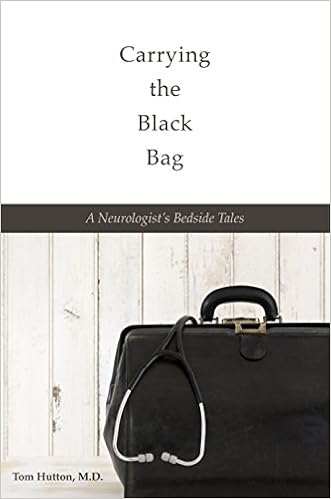
Carrying the Black Bag: A Neurologist's Bedside Tales by Tom Hutton, M.D.


Dr. Hutton's stories and life are quite interesting. He graduated from Baylor medical college and got his "black bag" upon graduation and that bag meant more to him than anything as it represented everything that a doctor is.  He went on do his internship at the the Hennepin County General Hospital (also known as "The General") in Minneapolis, a teaching hospital for the University of Minnesota, where he would would do his neurology residency. Eventually, he would take the job as neurology chief resident of the VA Medical Center in Minneapolis.  Then he and his family would move back to Texas in Lubbock where he would have an associate professor's job at a developing medical school where he would be creating a neurological clinical, teaching, and research program where none had existed before that would churn out not trained specialists, but primary care physicians. On top of this he would do a great deal of research into Parkinson's.

During his internship at The General he bemoans the fact that doctors can no longer do what he and others doctors did back then. Around midnight things would calm down and the house doctors would all be in the cafeteria getting something to eat and it would generally be a time for a bull session among interns and residents about cases that could sometimes lead to answers that saved lives.  Sometimes it was just a chance to let off steam about life in general.  These days doctors have little cubbie holes and don't as a rule meet in large groups to have bull sessions together like that anymore. On the other hand, The General is a much nicer hospital now than it was then when it was falling apart at the seams.

His first rotation scared him the most as it was the NICU and sure enough something went wrong. He went to change a boy's diaper and turned his back when suddenly the heat lamp exploded and shards of broken glass landed on the baby's body giving him temporary first degree burns. He completely freaks at what he believes to be a horrendous accident caused by faulty equipment, until a nurse comes in to help him and remarks that the kid must have the aim of Wild Bill Hickok. When he looks at her confused (as do I since I have a daughter not a son) she tells him that as soon as he took the diaper off the boy shot a stream of urine straight up and hit the heat lamp dead on causing the light to burst.  The baby boy was fine once the ointment was put on.  And he learned, as all parents of boys do, to watch out for the boys when changing their diapers.

When he did his maternity rotation the last thing he expected was that he might have to deliver his own kid.  It was one of the worst winters in Minnesota memory and Dr. Hutton's mother had come up from Texas to be with his wife Trudy.  However, when she went into labor even Minnesotans weren't driving out in the weather and the ambulance drivers weren't going out in it, either. So his mother, who had never driven in snow in her life, but was a crazy, and stubborn Texan set out to get her daughter-in-law to the hospital and did in fact get her there, though her son had to give her a Valium when she got there as her nerves were a bit shot. Dr. Hutton had delivered over 200 babies so this should be a piece of cake so long as nothing goes wrong. Something of course, went wrong. His wife was going to require a C-Section and the on-call doctor had already told him that he was snowed in at his house. Dr. Hutton had never even seen a C-Section done much less done one. Never mind doing one on his own wife. He went down and had a chat with the ambulance driver about what was at stake.  I like to think that maybe he shamed him a bit by telling him that his Texas mother made it there and she's never driven in snow before.  Nonetheless the ambulance driver went out and in an hour got the doctor and brought him back to perform the procedure.  Dr. Hutton and his wife had a beautiful baby boy named Andy.  A daughter Katie would follow a few years later.

One of his more memorable patients at the clinic in Texas was Mr. Woodley, an ornery seventy-five-year-old man from Muleshoe who had had Parkinson's for eight years when he first meets him. His wife has been dead for three years and his kids, with whom he is not close with, don't live in the state.  It takes some beating about the bush as to what is going on with Mr. Woodley. It turns out Mr. Woodley is having trouble shuffling cards and wants help with that.  If finally comes out that he plays pinochle with three dogs, a large yellow Labrador named Yellow Dawg, a black-and-white border collie named Skipper, and a small white-and-light-brown cocker spaniel named Coco. He makes sandwiches for them to eat and everything.  The whole scene reminds you of one of those dogs playing poker paintings. Hallucinations can be caused by medication for Parkinson's and as a doctor he should adjust the meds so Mr. Woodley no longer sees the dogs. But the more he talks to him the more he comes to realize how detrimental this would be to the man as he is so lonely out on his farm and the hallucinations are harmless.  This would not be the last problem he would have with Mr. Woodley. The other one would be much worse than this, which is saying a lot.

As a professor and not just a doctor, he had to do research. Publish or perish really does exist in academic circles.  He presented two scientific papers at an international conference in Vancouver, British Columbia. The first "on eye movements and Parkinson's disease, was carefully crafted and painstakingly presented, representing twenty years of my research. While politely received, the paper, I fear, was soon forgotten. My second, more speculative presentation, I had developed over the prior six months. It dealt with Hitler's Parkinson's disease and how his illness might have influenced the Battle of Normandy. My Hitler presentation, to my amazement, created great enthusiasm and immediately went viral."  After about ten years, Parkinson's can cause damage to the frontal lobe of the brain leading to impairment in the the ability to plan, execute, and determine effectiveness of decisions. The author is quick to note that this has nothing to do with any moral or ethical decisions he made during his time as leader of Germany, as he was not impaired that way at all. This is more along the lines of when he should attack the USSR. The idea was to attack them in 1944 when they had all their advanced weaponry, but he moved it up. He also failed to send in reinforcements at Normandy for two days which was a possible game changer in the war.   He refused to change his mind about the Allies attacking in Calais.  He was incapable of delegating smaller decisions to others and got mired down in the details.  The History Channel did a program on it called High Hitler, as Hitler's doctor treated him with some questionable drugs. Dr. Hutton worked on the United Kingdom's Chanel 4 on a program that was called Hitler's Hidden Drug Habit and in the United States it was on the National Geographic Chanel as Hitler the Junkie.

At the clinic, in order to have time to do his research he took on a nurse practitioner who is a real dynamo and a redhead, but I repeat myself.  Her name is Vicki and she has causes that stretch the length of Texas because her heart is so big and so fierce. In the book there are stories of the two of them working cases, but the big one is the cruise at the end of the book. At some point he began to take Parkinson's patients from wherever as long as they passed the physical, on a cruise of the Bahamas and that area. He and his staff would be the ship's specialists along with the on board doctor.  Over the years the cruise had grown in numbers and this last one he describes going on is like the cruise from hell in some aspects as things that had never gone wrong before are going wrong now, as doctors are green lighting patients who maybe should not be there.  At the same time, it's a joy to watch the indomitable human spirit as it refuses to give up and these men and women go on shore excursions or swimming with everything they have.

I really loved this book. Dr. Hutton really cares about his patients. In 1974 he had just embarked on the US-USSR Health Exchange Program to the University of Moscow fellowship. He got to work with the greatest Soviet neurologist Dr. Luria who taught him the importance of reading mysteries in preparing to be a doctor.  He also taught him the importance of viewing a patient's story from their perspective and of medical storytelling, which means getting a detailed account from the patient themselves as to what is going on in their lives, not just what the problem is, because it could all be connected.  This is a doctor that believes in sitting down with you and talking with you for a bit before he digs into to trying to figure out how to solve your problem because the two can be connected and because he cares.  He's not ashamed to admit when he openly weeps over a patient he barely knew for a short period of time.  These stories are sometimes a bit funny, or miraculous, or heartbreaking. They are all thought provoking and while he has retired from practicing medicine, the black bag is always at the ready.

Quotes:
 I asked Professor Luria what he considered to be good preparation for becoming a neuropsychologist and neurologist. The eminent clinician surprised me by answering that reading mysteries was a fine background. He revealed that identifying and cobbling together clues was really no different for making neurological diagnosis than it was for solving crimes. Sherlock Holmes and Hercule Poirot, I suppose, would have made fine neurologists.

-Tom Hutton, M.D. (Carrying the Bag: A Neurologist’s Bedside Tales p 10)
 Babylon in all its desolation is a sight no so awful/As that of the human mind in ruins.

-Scrope Berdmore Davies
 There is and elasticity in the human mind, capable of bearing much, but which will not show itself, until a certain weight of affliction be put upon it; its powers may be compared to those vehicles whose springs are so contrived that they get on smoothly enough when loaded, but jolt confoundedly when they have nothing to bear.

-Charles Caleb Colton
Link to Amazon: https://www.amazon.com/Carrying-Black-Bag-Neurologists-Bedside/dp/0896729540/ref=sr_1_1?s=books&ie=UTF8&qid=1471270812&sr=1-1&keywords=carrying+the+black+bag